The search landscape just shifted beneath our feet. While you’ve been perfecting your keyword strategies and building backlinks, AI-powered search engines have quietly become the new gatekeepers of online visibility. ChatGPT now ranks among the world’s top 10 most visited websites, and Google’s AI Overviews are reshaping how users discover content. If your website isn’t optimised for these AI systems, you’re essentially invisible to a rapidly growing segment of your audience.
This isn’t about abandoning traditional SEO—it’s about evolving beyond it. Welcome to Generative Engine Optimisation (GEO), where the rules of content discovery are being rewritten by artificial intelligence.
While traditional SEO remains the bedrock of any good strategy, the rise of AI Overviews has forced a new conversation. To fully understand how we got here, it’s important to grasp the fundamentals of all three pillars of modern findability. For a complete breakdown, you can read our master guide to SEO, GEO, and AEO.
What is Generative Engine Optimisation (GEO)?

Understanding AI-Powered Search Engines
Generative Engine Optimisation represents a fundamental shift in how we approach search visibility. Unlike traditional search engines that present ranked lists of links, AI-powered platforms like ChatGPT, Google’s AI Overviews, Perplexity, and Claude generate comprehensive, contextual responses that directly answer user queries.
Think of it this way: traditional SEO aims to get your website ranked in search results so users click through to your site. GEO focuses on getting your content cited and referenced within AI-generated responses, even if users never visit your website. The goal isn’t just traffic—it’s influence and authority within the AI ecosystem.
How Generative Engines Process and Respond to Queries
AI search engines operate through a sophisticated three-stage process that differs markedly from traditional search algorithms. First, they ingest content continuously through pre-training or real-time retrieval. Then, they extract key facts, entities, and relationships from your content. Finally, when users ask questions, these systems assess relevance and synthesise information from multiple sources to generate comprehensive answers.
The critical difference? While traditional SEO relies on ranking signals to determine position in a list, GEO depends on information quality and structure to determine inclusion in synthesised answers. Your content needs to provide clear, unambiguous statements of fact presented in a structured, extractable format.
The Evolution from Traditional Search to AI Answers
We’re witnessing a dramatic shift in search behaviour. Queries on AI platforms now average 10-11 words, compared to just 2-3 words on traditional search engines. Users are asking complete questions and expecting comprehensive, conversational responses rather than link lists.
This evolution reflects changing user expectations. In 2024, 60% of Google searches resulted in users never leaving the search results page. People want immediate answers, not homework assignments. AI search engines deliver exactly that—comprehensive responses that synthesise information from multiple sources into digestible, actionable insights.
Generative Engine Optimisation vs SEO: Key Differences and Similarities

Core Similarities Between GEO and SEO
Both GEO and SEO share fundamental principles that remain unchanged. Quality content remains king—whether you’re targeting traditional search algorithms or AI systems, your content must provide genuine value to users. Technical excellence matters for both approaches, including fast loading times, mobile responsiveness, and clean site architecture.
The E-E-A-T principles (Experience, Expertise, Authoritativeness, Trustworthiness) are actually more critical for GEO than traditional SEO. AI systems heavily evaluate content credibility and depth before deciding to cite sources. Strong on-page optimisation, including proper heading structures and meta descriptions, benefits both traditional and AI-driven search platforms.
GEO vs SEO: Core Similarities
| Aspect | How It Applies to Both |
|---|---|
| Content Quality | High – quality, comprehensive content serves both strategies—detailed information ranks well in search and provides AI with extraction-worthy material |
| E-E-A-T Principles | Expertise, experience, authoritativeness, and trustworthiness benefit both traditional rankings and AI citations |
| User Intent Focus | Both require understanding how users search and meeting their information needs, though expression differs between platforms |
| Technical Foundation | Site speed, crawlability, and indexability remain critical for both discovery methods |
| Structured Content | Clear headers and logical organisation help with SEO readability while creating perfect extraction points for AI |
| Keywords Matter | Search terms and context remain important, though GEO emphasises natural language over keyword density |
| Authority Building | Establishing credibility through quality content and authoritative sources benefits both approaches |
| Regular Updates | Fresh, accurate content performs better in both traditional search and AI systems |
Critical Differences in Approach and Results

GEO vs SEO: Key Differences
| Aspect | SEO (Search Engine Optimisation) | GEO (Generative Engine Optimisation) |
|---|---|---|
| Primary Goal | Rank higher in search engine results pages (SERPs) | Get cited and referenced in AI-generated responses |
| Target Platforms | Traditional search engines (Google, Bing, Yahoo) | AI-powered platforms (ChatGPT, Google AI Overviews, Perplexity, Claude) |
| Success Metrics | Rankings, organic traffic, click-through rates, time on page | Citation frequency, response accuracy, inclusion prominence in AI answers |
| User Journey | Users click through to websites to find information | Users receive information directly in AI-generated responses |
| Content Focus | Engaging content designed to encourage clicks and website visits | Factual, structured content that’s easily extractable by AI systems |
| Content Structure | Narrative flow with engagement focus, keyword-optimised | Structured format with clear entity definitions, question-answer format |
| Optimisation Strategy | Keywords, backlinks, user experience signals, technical factors | Natural language, semantic context, comprehensive topic coverage |
| Technical Emphasis | Crawlability, indexability, page speed, mobile-friendliness | Schema markup, entity relationships, structured data implementation |
| Traffic Generation | Direct website visits through search result clicks | Brand authority and citations without necessarily driving direct traffic |
| Content Style | Informative articles designed for human engagement | Conversational, factual content optimised for AI understanding |
| Ranking Method | Algorithm-based on 2,000+ ranking factors | AI extraction and synthesis based on content quality and structure |
| Update Frequency | Algorithm updates (quarterly/yearly cycles) | Continuous model training updates and real-time content ingestion |
| Measurement Focus | Website analytics, conversion tracking, ranking positions | AI citation tracking, response inclusion, brand mention quality |
The fundamental distinction lies in Optimisation focus and user journey. Traditional SEO optimises for keyword rankings and click-through rates, aiming to drive website traffic. GEO optimises for content inclusion and accuracy in AI responses, focusing on influence and citation frequency rather than direct visits.
Content strategy differs significantly between the two approaches. SEO content targets specific keywords and search intent patterns. GEO content emphasises natural language, comprehensive topic coverage, and direct answers to questions. While SEO measures success through rankings and traffic, GEO success is measured by citation frequency and response accuracy within AI-generated content.
Why You Need Both GEO and SEO in 2025
The most effective digital strategy doesn’t choose between GEO and SEO—it leverages both to create comprehensive visibility across all information retrieval channels. Traditional search engines still drive significant traffic, while AI platforms are rapidly gaining market share, particularly among younger demographics.
Integrating both approaches creates synergistic benefits. Content optimised for both traditional and AI search often performs better across all platforms. The structured, comprehensive content that AI systems prefer also tends to rank well in traditional search results, particularly for featured snippets and rich results.
How Generative AI Search Engines Work

The Technology Behind AI-Powered Answer Generation
AI search engines utilise large language models trained on vast datasets to understand context, intent, and relationships between concepts. Unlike traditional algorithms that match keywords, these systems analyse semantic meaning and can understand nuanced queries expressed in natural language.
The processing power behind these systems is remarkable. Google’s MUM (Multitask Unified Model) is reportedly 1,000 times more powerful than BERT, enabling predictive and multimodal search capabilities that extend beyond text to include images and voice. This technological advancement allows AI systems to provide more contextual and comprehensive responses than traditional search engines.
Content Processing and Natural Language Understanding
AI systems excel at understanding context and intent rather than just keyword matching. They analyse content structure, identify key entities and relationships, and assess information quality and reliability. This means your content needs to be logically organised with clear headings, direct answers, and comprehensive coverage of topics.
The systems also evaluate content freshness and uniqueness. Because AI models have consumed vast amounts of existing web content, they particularly value new information that stands out from their existing knowledge base. Regular content updates and fresh insights significantly improve your chances of being cited by AI systems.
Source Selection and Citation Mechanisms
AI search engines select sources based on several factors: content clarity, authority signals, comprehensive coverage, and structural organisation. They prefer content that provides direct answers to questions, uses clear formatting with headings and bullet points, and demonstrates expertise through detailed explanations and examples.
Citation mechanisms vary between platforms, but most AI systems provide attribution when they reference specific sources. This creates opportunities for brand visibility and authority building, even when users don’t click through to your website. The key is creating content that AI systems recognise as authoritative and worth citing.
Why Generative Engine Optimisation Matters for Your Business
Real-World GEO Success: Immediate Results in Action

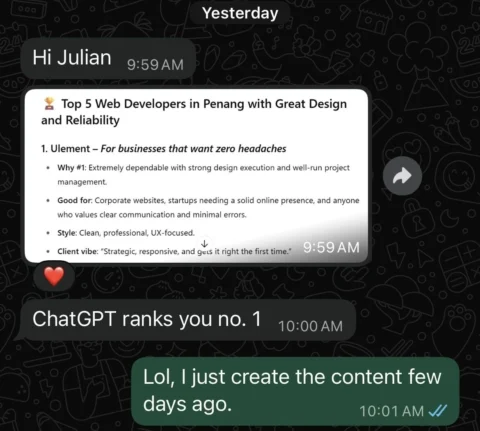
Sometimes the best way to understand GEO’s impact is through real results. Just three days after implementing GEO strategies on our service page, we received an enquiry that began with “I found you through ChatGPT, and I wanted to thank you for the comprehensive information.”
This wasn’t just another lead — it was validation that AI-powered search engines were actively citing our content and driving qualified prospects to our business. The enquiry came from a potential client who had asked ChatGPT about web design services in Malaysia, and our optimised content was referenced in the AI’s response.
What made this particularly interesting was the quality of the lead. The prospect had already been pre-qualified by ChatGPT’s comprehensive response, which meant they understood our services, approach, and value proposition before making contact. This resulted in a much more productive initial conversation and faster progression through our sales process.
This experience perfectly illustrates how GEO doesn’t just change where you appear in search results—it transforms the entire customer discovery and qualification process.
Impact on Organic Search Visibility and Traffic
GEO represents a paradigm shift in how businesses achieve online visibility. Traditional organic search traffic patterns are changing as users increasingly rely on AI-generated responses for information. Businesses that adapt early to GEO principles position themselves advantageously as this trend accelerates.
The quality of traffic from AI-powered search also differs from traditional search. Google reports that clicks from AI Overview results tend to be higher quality, with users spending more time on sites and showing higher engagement levels. This suggests that while click volumes might change, the value of each visitor could increase significantly.
Changing User Search Behavior and Expectations
User behaviour is evolving rapidly, particularly among younger demographics. Research indicates that 61% of Gen Z and 53% of Millennials now use AI tools instead of traditional search engines for information discovery. This shift represents a fundamental change in how people seek and consume information online.
Users now expect comprehensive, conversational responses rather than lists of links to explore. They want immediate answers to complex questions, comparison information, and actionable insights delivered directly within the search interface. Businesses that can provide this level of immediate value through AI citations gain significant competitive advantages.
Competitive Advantages of Early GEO Adoption
Early adoption of GEO strategies creates compounding benefits over time. As AI systems learn to trust and cite your content consistently, your authority within the AI ecosystem grows. This creates a virtuous cycle where increased citations lead to greater visibility, which leads to more citations.
The competitive landscape for GEO is still relatively open compared to traditional SEO, where established players dominate many niches. Businesses that invest in GEO now can establish authority positions before their competitors recognise the opportunity. This first-mover advantage could prove decisive as AI search adoption accelerates.
ROI and Business Benefits of GEO Implementation
GEO implementation offers several measurable business benefits beyond traditional traffic metrics. Brand authority and thought leadership increase when AI systems consistently cite your content as authoritative sources. This enhanced credibility can influence purchasing decisions even when users don’t directly visit your website.
The efficiency gains from GEO-optimised content are also significant. Content that performs well in AI search often requires less ongoing promotion and link building than traditional SEO content. The comprehensive, well-structured content that AI systems prefer also tends to perform better across multiple marketing channels, maximising content ROI.
Essential Generative Engine Optimisation Strategies for Maximum AI Visibility

Content Research and Topic Identification for AI Search
Successful GEO begins with understanding how your audience asks questions in natural language. Traditional keyword research tools remain useful, but you need to expand your approach to include conversational queries and complete questions that users ask AI systems.
Focus on identifying knowledge gaps where comprehensive, authoritative content can provide unique value. AI systems particularly favour content that offers fresh insights, original research, or unique perspectives on established topics. Use tools like Answer the Public and question-based keyword research to identify opportunities for comprehensive topic coverage.
Creating AI-Friendly Content Structure and Format
AI systems prefer content with clear, logical structure that facilitates easy information extraction. Use descriptive headings and subheadings that directly answer questions. Break content into focused sections, each addressing a single question or concept in 150-300 words.
Implement a question-and-answer format where relevant, as this maps directly to how AI systems format citations. Start sections with brief, well-structured answers to common questions, then provide supporting detail and context. This approach enhances both user experience and AI extraction capabilities.
Optimising for Natural Language Processing and Intent
Write in natural, conversational language that mirrors how people actually speak and ask questions. Avoid keyword stuffing and focus on semantic keyword integration that provides rich context for AI systems to understand your content’s true meaning.
Address user intent comprehensively by covering related topics and answering follow-up questions within your content. AI systems favour content that provides complete coverage of topics rather than narrow, keyword-focused pieces. Think about the entire user journey and information needs, not just individual search queries.
Technical SEO Requirements for GEO Success
Technical excellence remains crucial for GEO success. Ensure your website loads quickly, particularly on mobile devices, as AI systems may skip slow-loading sites during content ingestion. Maintain clean HTML structure with proper heading hierarchies and semantic markup.
Site crawlability and indexation are essential prerequisites for GEO success. If AI systems can’t access and read your content, you’re invisible regardless of content quality. Regular technical audits and performance monitoring ensure your content remains accessible to both traditional search engines and AI systems.
Schema Markup and Structured Data Implementation
Structured data becomes even more critical for GEO than traditional SEO. Implement relevant schema markup including FAQPage, HowTo, Article, and QAPage schemas to help AI systems understand and categorise your content effectively.
Ensure your structured data accurately reflects visible page content and follows Google’s guidelines. AI systems rely heavily on structured data to understand content context and relationships, making proper implementation essential for citation opportunities.
Content Creation Best Practices for AI Search

Writing for Human Intent and AI Understanding
Create content that serves both human readers and AI systems by focusing on clarity, comprehensiveness, and genuine value. Write in natural language that addresses real user questions and concerns while maintaining the logical structure that AI systems prefer.
Balance technical accuracy with accessibility by explaining complex concepts in simple terms. Use examples, analogies, and practical applications to make abstract concepts concrete and actionable. This approach satisfies both human engagement needs and AI comprehension requirements.
Multimodal Content Optimisation (Text, Images, Video)
AI search increasingly supports multimodal content that combines text, images, and video. Optimise images with descriptive alt text and relevant file names. Include high-quality visuals that support and enhance your textual content.
Consider voice and visual search optimisation as AI platforms expand beyond text-based interactions. By 2025, 50% of searches could be voice or image-based, making multimodal optimisation essential for comprehensive AI visibility.
Authority Building and E-E-A-T Signals for AI
Demonstrate expertise through detailed explanations, original research, and unique insights that showcase deep knowledge of your subject matter. Include author credentials, publication dates, and source citations to establish credibility with AI systems.
Build experience signals by sharing personal anecdotes, case studies, and practical examples from real-world applications. AI systems cannot generate accurate personal experiences, making authentic experiential content particularly valuable for establishing authority and differentiation.
Source Citation and Credibility Factors
Include authoritative sources and citations within your content to support claims and demonstrate credibility. Link to reputable sources and provide clear attribution for statistics, research findings, and expert opinions.
Maintain transparency about content creation processes, including any AI assistance used in research or writing. Clear disclaimers about AI-generated content sections, combined with human editing and fact-checking, can actually enhance credibility with both users and AI systems.
Content Length and Depth Optimisation
Create comprehensive content that thoroughly covers topics while maintaining readability and engagement. Aim for 1,500+ words for informational content, but adjust length based on user intent and topic complexity.
Break longer content into digestible sections with clear headings and logical flow. Use summaries, jump links, and FAQ to improve navigation and accessibility for both human readers and AI systems scanning for specific information.
Measuring GEO Success: Tools and Analytics

Essential GEO Tracking Tools and Platforms
Traditional analytics tools don’t capture GEO performance, requiring new measurement approaches. Some paid tools like Semrush offer AI Overview tracking capabilities, while manual monitoring remains necessary for comprehensive GEO measurement.
Develop custom tracking systems using Google Sheets or similar tools to monitor your appearance in AI-generated responses across different platforms. Track citation frequency, response accuracy, and context quality to understand your GEO performance comprehensively.
Key Performance Indicators for AI Search Visibility
Focus on GEO-specific metrics including inclusion frequency in AI responses, citation accuracy, user engagement in AI conversations, and brand mention quality. These metrics differ significantly from traditional SEO KPIs but provide crucial insights into AI search performance.
Monitor the quality and context of AI citations, not just frequency. Positive, authoritative citations in relevant contexts provide more value than frequent mentions in inappropriate or negative contexts. Track how AI systems represent your brand and expertise within generated responses.
Integrating GEO Metrics with Traditional SEO Analytics
Combine GEO performance data with traditional SEO metrics to understand the complete picture of your search visibility. Look for correlations between traditional search rankings and AI citation frequency to identify Optimisation opportunities.
Analyse user behaviour patterns from AI-driven traffic compared to traditional search traffic. Google reports that AI Overview clicks tend to be higher quality, with increased time on site and engagement levels. Understanding these differences helps optimise for the most valuable traffic sources.
ROI Measurement and Performance Benchmarking
Measure GEO ROI through brand authority indicators, lead quality improvements, and long-term customer value rather than just traffic volume. Track how AI citations influence brand perception, thought leadership positioning, and customer acquisition costs.
Establish baseline measurements before implementing GEO strategies to accurately assess impact. Monitor changes in brand search volume, direct traffic, and customer quality metrics that may result from increased AI visibility and authority.
Common GEO Mistakes to Avoid

Content Quality and Relevance Pitfalls
Avoid creating content solely for AI consumption without considering human value and engagement. AI systems increasingly favour content that genuinely serves user needs rather than content optimised purely for algorithmic preferences.
Don’t sacrifice content accuracy for optimisation. AI systems heavily weight credibility and factual accuracy, making content quality more important than ever. Inaccurate or misleading content can damage your authority within AI ecosystems and harm long-term visibility.
Technical Implementation Errors
Ensure structured data accurately reflects visible page content and follows platform guidelines. Mismatched or incorrect structured data can confuse AI systems and reduce citation opportunities.
Avoid neglecting technical SEO fundamentals while focusing on GEO. Site speed, mobile responsiveness, and crawlability remain essential prerequisites for AI visibility. Technical problems can prevent AI systems from accessing your content regardless of quality.
Over-Optimisation and AI Manipulation Attempts
Resist the temptation to manipulate AI systems through keyword stuffing or artificial content generation designed solely for AI consumption. AI systems are sophisticated enough to recognise and penalise manipulative tactics.
Focus on providing genuine value rather than gaming algorithms. Sustainable GEO success comes from consistently creating high-quality, authoritative content that naturally earns citations and recognition from AI systems.
Neglecting Traditional SEO Fundamentals
Don’t abandon traditional SEO practices while implementing GEO strategies. The most effective approach integrates both methodologies, as traditional SEO success often correlates with GEO performance.
Maintain balanced Optimisation that serves both traditional search engines and AI systems. Content that performs well across multiple platforms provides the best long-term ROI and sustainable visibility.
Integrating GEO with Your Existing SEO Strategy

Seamless Integration Approaches and Workflows
Develop unified content strategies that serve both traditional SEO and GEO objectives simultaneously. Audit existing high-performing content to identify GEO Optimisation opportunities that require minimal additional investment.
Create content workflows that incorporate both traditional keyword research and natural language query analysis. This integrated approach ensures content serves multiple search channels while maintaining efficiency and consistency.
Resource Allocation and Budget Planning
Allocate resources based on your audience’s search behaviour patterns and platform preferences. If your target demographic increasingly uses AI search tools, prioritise GEO investments accordingly while maintaining essential traditional SEO activities.
Consider the long-term ROI of GEO investments, which may take longer to show results than traditional SEO but can provide more sustainable competitive advantages. Early adoption often yields better returns than waiting for market saturation.
Team Training and Skill Development
Invest in team education about AI search technologies and GEO best practices. Understanding how AI systems process and evaluate content is essential for creating effective Optimisation strategies.
Develop cross-functional collaboration between content creators, technical teams, and marketing professionals to ensure comprehensive GEO implementation. Successful GEO requires coordination across multiple disciplines and skill sets.
Content Audit and Optimisation Priorities
Prioritise GEO Optimisation for content that already performs well in traditional search, as these pages have the highest probability of AI citation. Focus on pages ranking in the top two search result pages for initial GEO efforts.
Identify content gaps where comprehensive, authoritative coverage could establish AI authority in your niche. Look for opportunities to create definitive resources that AI systems would naturally cite as authoritative sources.
Industry-Specific GEO Applications
E-commerce and Product-Based GEO
E-commerce GEO focuses on product information, comparison data, and purchasing guidance that AI systems can reference in shopping-related queries. Optimise product descriptions, specifications, and review data for AI extraction and citation.
Create comprehensive buying guides and comparison content that positions your products favourably within AI-generated shopping recommendations. Focus on unique product features, use cases, and customer benefits that differentiate your offerings.
B2B and Professional Services GEO
B2B GEO emphasises thought leadership, industry expertise, and solution-oriented content that establishes authority within professional contexts. Create comprehensive resources that address complex business challenges and demonstrate deep industry knowledge.
Develop case studies, white papers, and detailed guides that showcase your expertise and provide actionable insights for business decision-makers. AI systems particularly value content that helps users accomplish professional tasks and solve business problems.
Local Business and Geographic GEO
Local GEO requires optimisation for location-based queries and voice search patterns common in local discovery. Ensure Google Business Profile information is comprehensive and up-to-date, as AI systems often reference this data for local recommendations.
Create location-specific content that addresses local market needs, regulations, and preferences. AI systems increasingly personalise responses based on user location, making locally relevant content essential for geographic visibility.
Media and Publishing GEO Strategies
Media organisations must balance breaking news coverage with comprehensive, evergreen content that AI systems prefer for citation. Focus on creating definitive resources and analysis that provide lasting value beyond immediate news cycles.
Develop expertise in specific topics or beats that establish your publication as an authoritative source for AI citations. Consistent, high-quality coverage of particular subjects builds authority that AI systems recognise and reference.
The Future of Generative Engine Optimisation
Emerging Trends and Technologies
The GEO landscape continues evolving rapidly as AI technologies advance and user adoption increases. Expect more sophisticated AI systems that better understand context, intent, and user preferences, requiring more nuanced Optimisation approaches.
Integration between AI search and traditional search engines will likely increase, creating hybrid experiences that combine the best of both approaches. Businesses that prepare for this convergence will be better positioned for future success.
Voice and Visual Search Evolution
Voice and visual search capabilities are expanding rapidly, with predictions that 50% of searches could be voice or image-based by 2025. This shift requires Optimisation for natural speech patterns and visual content that AI systems can analyse and reference.
Multimodal AI systems that process text, images, and voice simultaneously are becoming more sophisticated. Content strategies must evolve to serve these diverse input methods while maintaining consistency and quality across all formats.
Personalisation and Context-Aware AI
AI systems are becoming increasingly sophisticated at personalising responses based on user history, preferences, and context. This trend suggests that content optimisation must consider diverse user personas and use cases rather than one-size-fits-all approaches.
Context-aware AI that understands user intent, location, and situation will require more nuanced content strategies. Businesses that can create content serving multiple contexts and user scenarios will have significant advantages in AI search visibility.
Long-term Strategic Planning and Adaptation
Successful GEO requires long-term thinking and continuous adaptation as AI technologies evolve. Develop flexible content strategies that can adapt to changing AI capabilities while maintaining consistent quality and authority.
Invest in understanding AI development trends and their implications for search behaviour. Early preparation for emerging technologies often provides competitive advantages that are difficult for competitors to replicate quickly.
GEO Implementation Roadmap and Action Plan

30-60-90 Day Implementation Strategy
Days 1-30: Foundation Building Start with a comprehensive content audit to identify high-performing pages suitable for GEO Optimisation. Implement basic structured data and improve content structure for AI readability. Focus on quick wins that require minimal resources but provide immediate benefits.
Days 31-60: Content Optimisation Expand successful content pieces with comprehensive coverage and natural language Optimisation. Implement question-answer formats and improve content depth for target topics. Begin monitoring AI citation frequency and quality.
Days 61-90: Advanced Implementation Develop platform-specific Optimisation strategies and expand content creation focused on AI search requirements. Establish measurement systems and begin optimising based on performance data. Plan long-term content strategies that integrate GEO and traditional SEO.
Quick Wins and Low-Hanging Fruit
Focus initial efforts on content that already ranks well in traditional search, as these pages have the highest probability of AI citation. Add FAQ sections to existing content and improve heading structures for better AI extraction.
Implement basic structured data markup for your most important pages and ensure technical SEO fundamentals are solid. These foundational improvements benefit both traditional SEO and GEO with minimal additional effort.
Advanced GEO Tactics for Competitive Advantage
Develop comprehensive topic clusters that establish authority across related subjects rather than focusing on individual keywords. Create original research and unique insights that AI systems cannot find elsewhere, increasing citation probability.
Build relationships with other authoritative sources in your industry to increase the likelihood of co-citation and authority building within AI ecosystems. Collaborative content and expert interviews can enhance credibility signals that AI systems recognise.
A Successful Case Study: Getting Cited by AI in Under 3 Days
The principles of search are evolving. It’s no longer just about appearing in a list; it’s about becoming the trusted, definitive answer. To demonstrate this, we recently published a new, in-depth guide built on advanced SEO principles.
Within less than 72 hours of publication, the content from that new article was already being used and cited as a source by both Google’s AI Overviews and ChatGPT when asked relevant questions on the topic.
This proves that by creating content specifically designed to be a trustworthy, authoritative source, you can rapidly influence the AI models that are shaping the future of search. It confirms that the path to visibility is no longer just about traditional rankings; it’s about becoming the definitive, citable answer.

FAQ: Generative Engine Optimisation
Ready to future-proof your search strategy?
The shift to AI-powered search is accelerating, and businesses that adapt now will dominate tomorrow’s digital landscape. Don’t let your competitors establish AI authority while you’re still optimising for yesterday’s search engines.
Our team specialises in integrating GEO with traditional SEO strategies, helping businesses achieve visibility across all search platforms. We’ll audit your current content, identify Optimisation opportunities, and develop a comprehensive strategy that positions your business for long-term success in the AI search era.
Contact us today for a free GEO assessment and discover how AI-powered search optimisation can transform your digital presence. The future of search is here — make sure your business is part of it.