Google penalty recovery is a remedial process that identifies and rectifies website violations to restore organic search visibility. Traffic drops usually stem from silent algorithmic devaluations or explicit manual actions triggered by low-quality optimisation tactics. Recovery requires a forensic audit, strategic link analysis, and a complete rebuild of E-E-A-T signals.
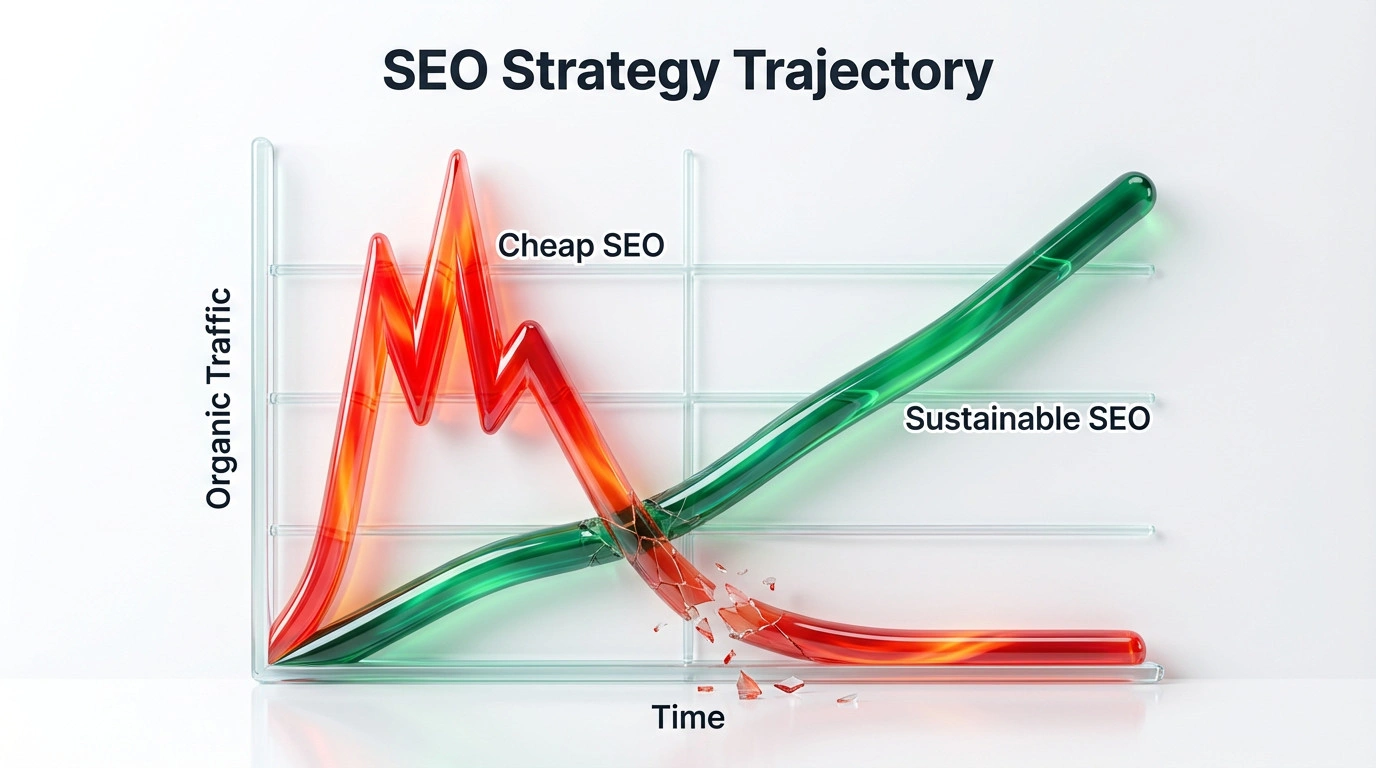
Cheap SEO services often function like high-interest debt; you get a quick influx of “results” that you pay for heavily later. Business owners frequently discover that the initial spike in traffic was built on a foundation of spam. Cleaning up this mess costs far more than doing it right the first time, since you must undo the damage before any real growth can resume. A proper professional SEO service builds value that lasts.
What is the anatomy of a “Cheap SEO” disaster?
Cheap SEO strategies are automated tactics that prioritise volume over quality to manipulate search rankings temporarily. These methods leave distinct footprints that search engine algorithms associate with spam.
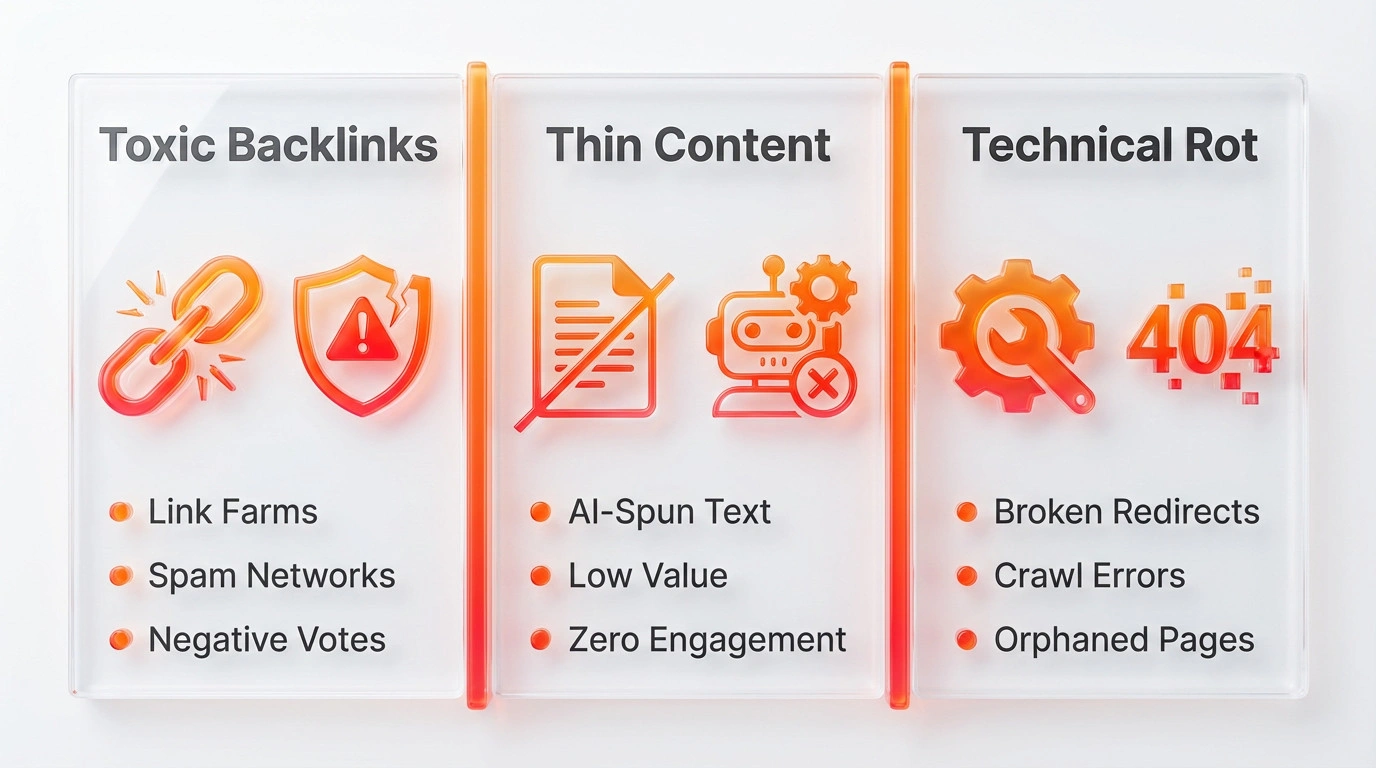
Low-cost agencies often ignore long-term domain health in favour of quick wins. It is critical to distinguish the damage: Manual Actions trigger a notification in Google Search Console, whereas Algorithmic Devaluations (like the Helpful Content system) silently suppress rankings without warning. We categorise the damage into three primary areas of “rot” that must be excised.
How do toxic backlinks harm a website?
Toxic backlinks are unnatural inbound links that manipulate PageRank and violate Google’s Spam Policies. These links act as “negative votes” against a domain’s trustworthiness.
Link farms and $5 Fiverr gigs create thousands of low-quality connections overnight. Search engines view this sudden influx as an attempt to game the system. A website associated with known spam networks loses credibility immediately. We see this often: a sudden spike in referring domains followed closely by a precipitous drop in keyword rankings.
Why does thin content trigger penalties?
Thin content is low-value material that lacks depth, originality, or utility for the user. This content fails to satisfy user intent and wastes crawl budget.
AI-spun content has exacerbated this issue. Cheap providers generate thousands of pages targeting every city or keyword variation without adding unique value. The Google “Helpful Content” system specifically targets this robotic, repetitive text. If a page exists solely to rank rather than to inform, it is a liability. Users bounce quickly, sending negative engagement signals back to the algorithm.
What is technical rot in SEO?
Technical rot is the accumulation of structural errors that hinder search engine crawlers from indexing a site effectively. These errors obscure high-quality content from being discovered.
Broken redirects, canonical errors, and orphaned pages act like roadblocks for Googlebot. When a site is flooded with low-quality pages, the crawl budget is wasted on trash rather than treasure. Cleaning this mess requires a granular look at the site architecture.
How does the recovery process work?
The SEO recovery process is a systematic restoration phase involving auditing, cleaning, and rebuilding a website’s authority. This phase focuses on removing penalties and establishing a clean baseline for growth.
Restoration is rarely quick. Search engines need time to recrawl the site and process the changes. The focus shifts from “growth at all costs” to “stability and compliance”.
Step 1: The Audit
A forensic SEO audit is a comprehensive analysis that identifies technical, content, and off-page issues affecting performance. This document serves as the roadmap for all recovery efforts.
Audits go beyond basic automated checks. Analysts use tools like Ahrefs, SE Ranking, and Majestic to review crawl stats, and link profiles. Identifying the exact date of a traffic drop helps correlate the decline with specific Google Core Updates or site changes.
Step 2: The Detox
Link detoxification is the removal or disavowal of harmful backlinks to lift algorithmic suppression. This step signals to Google that the site no longer endorses spammy connections.
Disavow files must be submitted with extreme caution. We manually review referring domains to ensure high-quality links are not accidentally severed. In many modern cases, simply ignoring the spam is safer unless a Manual Action is present. Content pruning is equally vital here; deleting or no-indexing thin pages consolidates authority to the URLs that actually matter.
Step 3: The Rebuild
E-E-A-T is a Google quality framework evaluating Experience, Expertise, Authoritativeness, and Trustworthiness. Rebuilding involves demonstrating these qualities through robust, expert-authored content.
Trust is the currency of the modern web. We establish this by updating “About Us” pages, citing credible sources, and ensuring authors have verifiable digital footprints. Google must understand who is behind the content and why they are qualified to write it.
From Recovery to Sustainable Growth
Sustainable SEO is a long-term strategy that focuses on user experience and technical excellence to build compounding organic traffic. This approach prioritises steady growth over volatile spikes.
Safe SEO protects your business from the volatility of Google Core Updates. By aligning with search engine guidelines rather than trying to outsmart them, your site becomes an asset rather than a risk. Traffic may grow slower initially, but the foundation is solid.
SOP: The Modern Link Detox Checklist
Link Detox is a filtration process that separates high-value references from spammy associations to protect domain authority. Use this standard operating procedure (SOP) to audit your backlink profile without causing self-inflicted damage.
Phase 1: Data Collection
- Step 1: Aggregate Sources. Do not rely on a single tool. Export backlink data from Google Search Console (the primary truth), Ahrefs, and SE Ranking.
- Step 2: Consolidate & De-duplicate. Merge these lists into a single spreadsheet (Excel/Google Sheets) and remove duplicate URLs to create a master “candidate list”.
Phase 2: Analysis (The “Safe” Filter)
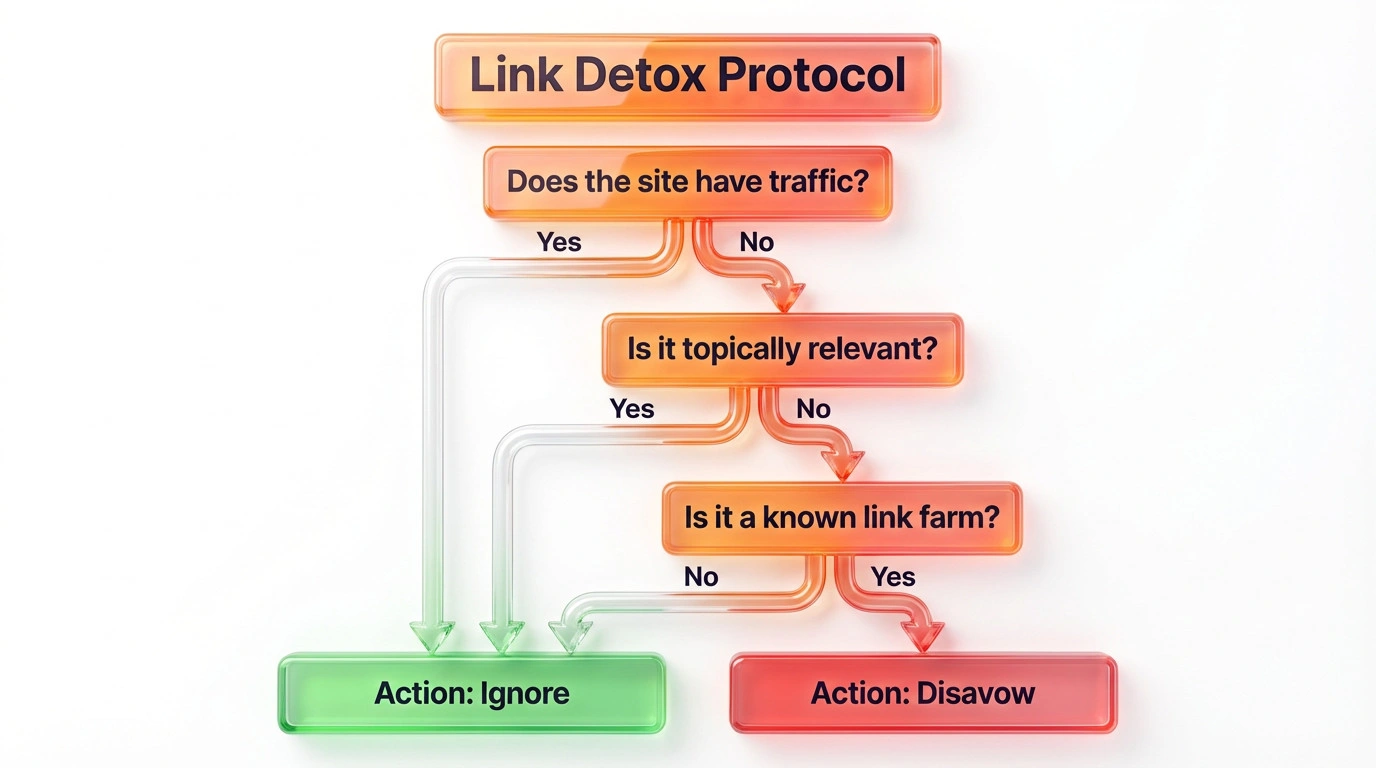
- Step 3: Filter by Traffic. Check if the referring domain has organic traffic.
- Rule: If a site has zero traffic in Ahrefs/Semrush, it is likely a link farm or PBN (Private Blog Network). Mark for manual review.
- Step 4: Check Topical Relevance. Does the linking site match your industry?
- Example: A “Cheap Ray-Bans” site linking to a “SaaS Accounting” site is a red flag.
- Step 5: Identify Patterns. Look for repetitive anchor text (e.g., exact match “Buy SEO Services”) appearing hundreds of times from unrelated domains.
Phase 3: Action (The 2026 Protocol)
- Step 6: The “Ignore” Bucket. For random blogspam or low-tier directories, do nothing. Google’s algorithms are efficient at ignoring these automatically.
- Step 7: The “Disavow” Bucket. Only list domains here if:
- You have a Manual Action notification in GSC.
- You are under an active Negative SEO attack (thousands of spam links in days).
- The links are from obvious “bad neighbourhoods” (gambling/pharma) that are growing aggressively.
- Step 8: Submission. Upload your text file (
disavow.txt) to the Google Disavow Tool.- Format:
domain:spammy-site.com(Do not disavow individual URLs; disavow the whole domain).
- Format:
Conclusion
Your business is too valuable for risky shortcuts. Cheap SEO leaves scars that take months and significant budget to heal. Let’s build a foundation that lasts.
FAQs
Successful Google penalty recovery is not a quick fix; it is a disciplined rebuild of trust signals across links, content, and technical health. Start with a full audit, then prioritise the issues that hurt rankings most. For a deeper walkthrough, see our SEO insights blog for related guides.