Have you ever been denied access to your own website, locked out by your agency, or unsure who really controls your online presence? If you’re like most business owners, you’ve probably wondered about this at some point. Ownership confusion isn’t just a nuisance, it’s a liability that could jeopardise your business.

What Is Website Ownership?
Website ownership means having full control over your domain, hosting, CMS, content, and licences. It includes admin access rights that allow you to update, modify, and maintain your website without restrictions. Owning your website legally and technically ensures you can make crucial decisions without third-party interference.
Most business owners don’t realise how crucial this is until they face it themselves—but understanding these fundamentals can save you significant stress and expense down the line.
Common Agency Pitfalls
Many clients face issues where agencies withhold admin access or mislead about how the website was built. This leads to situations where the client cannot manage or transfer the website independently, effectively holding their business online presence hostage.
Like many Malaysians, you probably want full control and peace of mind over your website. Transparency and honesty from your web partner are essential to avoid these costly nightmares. You’re likely to benefit from understanding these facts firsthand.
Real-World Consequences: Legal Action and Recurring Client Emergencies
We’ve witnessed first-hand the serious legal and operational consequences when agencies fail to provide proper website ownership transparency. These aren’t theoretical risks—they’re recurring problems that affect Malaysian businesses regularly.
Legal Action Against Web Agencies
We’ve seen cases where clients have taken legal action against their previous web agencies due to lack of transparency and being held hostage over their own websites. These situations arise when agencies:
- Withhold critical access credentials
- Restrict administrative control without justification
- Refuse to hand over ownership rights despite contract completion
- Use website access as leverage for additional payments
Legal proceedings often become necessary when all other attempts to regain control fail, but these cases are costly and stressful for business owners, exactly the situation you want to avoid by choosing transparent partners from the start.
A Recurring Industry Problem
Moreover, we frequently assist clients encountering problems caused by lack of website ownership. Alarmingly, this scenario repeats every few months, with new businesses falling victim to agencies that fail to provide full transparency or proper handover.
Common emergency scenarios we handle:
- Website completely inaccessible during business-critical periods
- Security breaches that cannot be addressed due to restricted access
- Urgent content updates blocked by unresponsive agencies
- Domain or hosting accounts held under agency control
- SSL certificates expiring with no way to renew
- Domain expired and losing domain due to lack of renewal access
- Hosting expired and losing everything including all website data and emails
These clients reach out for help only once issues become urgent, illustrating how widespread and persistent this problem is within the Malaysian web development industry.
Most business owners think it won’t happen to them, until they face a website emergency and discover they don’t actually control their own digital presence.
The Real Cost of Poor Ownership Practices
- Legal fees: Often exceeding the original website development cost
- Business disruption: Lost sales during downtime periods
- Emergency migration costs: Rush jobs are always more expensive
- Reputation damage: Professional credibility suffers when websites fail
- Stress and time: Countless hours dealing with problems instead of running your business
- Permanent data loss: When hosting expires without backup access
- Domain loss: Competitors or domain squatters can acquire expired domains
These situations are entirely preventable with proper ownership documentation and transparent partnerships. Every emergency we handle reinforces why clear ownership rights and transparent communication aren’t optional, they’re essential business protection.
Why Website Ownership Matters for Business Safety & Growth
Without real ownership, your website is vulnerable to hijacking, downtime, and expensive migrations. From a financial point of view, lacking control can lead to hidden fees and inability to respond to urgent changes. SEO benefits too: Google and AI systems prefer transparent, credible ownership signals which boost your search visibility and brand trust.
You might have encountered some of these hidden challenges without knowing exactly why your site wasn’t performing as expected.
Malaysian Legal and Technical Standards
Malaysian businesses must understand legal aspects like domain registration and contractual rights, alongside technical standards such as secured admin credentials, systematic documentation, and clear service-level agreements for ongoing support to ensure full ownership and control.
It’s something every growing business must consider sooner or later, the question is whether you’ll address it proactively or reactively.
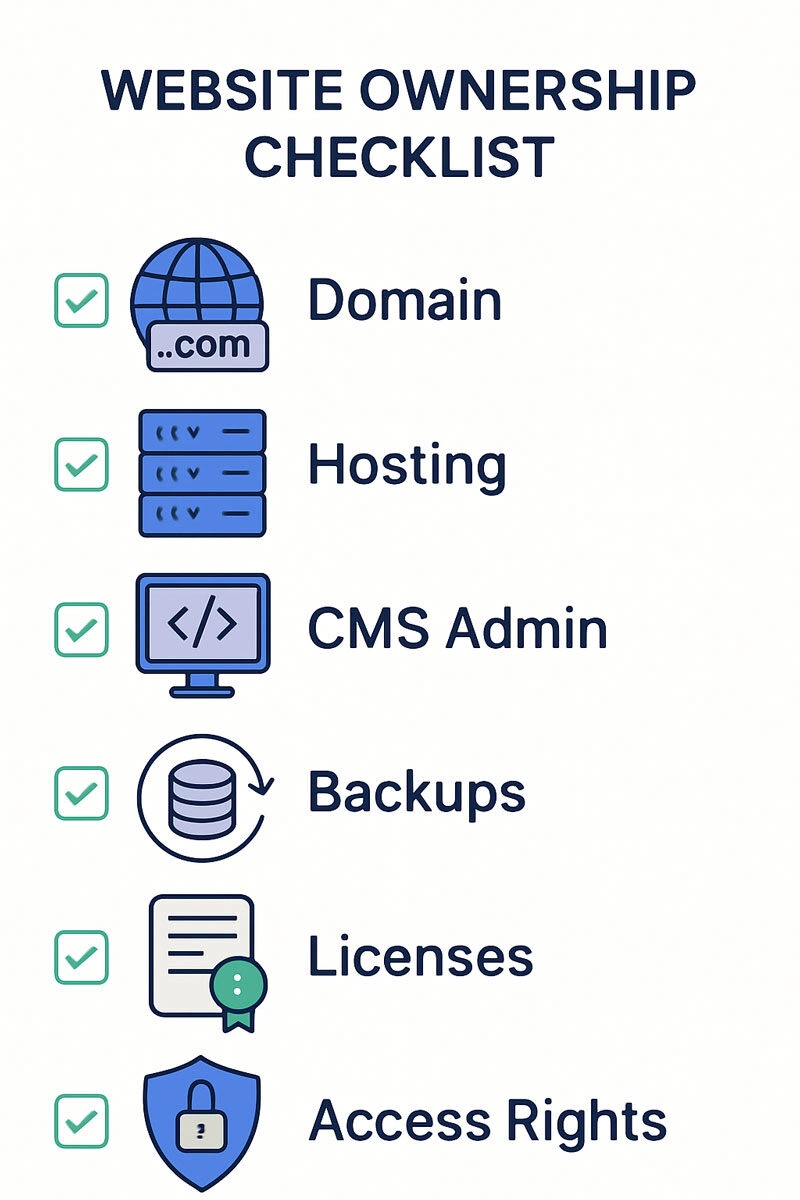
Website Ownership Checklist
Before, during, and after your website build, verify you’ve received all access credentials, confirm domain registration details, and ensure complete backup and licence handover.
Essential Questions to Ask:
- Have I received all access credentials?
- Is the domain registered in my name?
- Are backups and licences fully handed over?
- Can I make changes independently?
Red Flags to Watch:
- Limited admin roles or restricted access
- Vague contracts without clear handover terms
- Reluctance to share documentation
- “Trust us” responses to ownership questions
Many business owners think they’re protected, until it’s almost too late to take action without significant cost or disruption.
How to Take Full Control of Your Website
Conduct a thorough audit of your current website access and ownership status. If locked out, begin recovery by contacting your domain registrar or hosting provider. Transition carefully from risky agencies, preserving data and SEO value.
Recovery Process:
- Audit current access to all website systems
- Contact registrars directly if domain access is blocked
- Export content and databases before making changes
- Migrate carefully to preserve SEO value
- Document everything for potential legal needs
It’s surprising how often these issues are overlooked, even by experienced companies. If you’ve ever felt frustrated by lack of transparency, you’re not alone.
Transparency: What Good Handover Looks Like
A comprehensive handover includes documented access to domain, hosting, CMS login, databases, backups, licences, and source files. Clear instructions, timelines, and contact points ensure independent operation from day one.
Complete Handover Package:
- Domain registrar access and transfer codes
- Full hosting control panel credentials
- CMS admin access with no restrictions
- Database access and backup files
- All licence documentation
- Original design and development files
- Clear setup and maintenance instructions
Your Website Footer Isn’t Free Advertising Space
Your website footer should reflect your business identity, not serve as permanent advertising for your web agency. Whilst credit where due is professional, your footer is valuable real estate that belongs to you, not a billboard for someone else’s services.
Why This Matters More Than You Think
Many agencies automatically insert “Website designed by Agency Name” or “Powered by Company” links in client footers, often without explicit permission. Like most business owners, you might not have noticed this immediately, but these links can actually impact your professional image and SEO.
The Hidden Problems with Agency Footer Links:
- Unprofessional appearance: Visitors see your site as an extension of another company
- SEO link juice leakage: Your footer links pass authority to your agency instead of internal pages
- Brand confusion: Multiple agency credits make your site look like a template showcase
- Lack of control: Some agencies use footer links to promote competing services
What Your Footer Should Actually Contain:
Your Business Information:
- Company name and registration details
- Contact information and business address
- Copyright notice in your business name
- Links to your privacy policy and terms
- Professional certifications or memberships
- Social media links for your business
Not This:
- “Web design by Agency Name”
- “Powered by Platform” (unless legally required)
- Links to your agency’s other clients
- Generic template attribution
- Competitor or third-party promotional content
The Professional Approach to Agency Credit
If you want to acknowledge your web development partner, consider creating a dedicated “Credits” or “Acknowledgements” misc page on your website where you can list your agency, team members, and partners. This approach:
- Keeps your footer clean and professional
- Maintains your brand as the primary focus
- Provides appropriate recognition without visual clutter
- Allows for more detailed acknowledgements if desired
Example of appropriate credit in misc page: “Website developed in partnership with Agency” (without clickable promotional links)
Most Successful Businesses Keep Clean Footers
It’s surprising how often these issues are overlooked, even by experienced companies. Your website footer is prime real estate for building trust with visitors and supporting your SEO, not promoting someone else’s business.
Action Steps:
- Review your current footer for any third-party promotional content
- Remove or minimise agency attribution that doesn’t serve your business
- Add valuable business information that builds credibility
- Ensure all footer links support your business goals, not others’
- Include proper copyright in your business name
A professional website represents your business exclusively. Whilst we’re proud of our work, our clients’ success is more important than our promotion. That’s why we keep footer attribution minimal and always prioritise our clients’ branding and business objectives.
How We Do It (Professional Credit Without Public Footer Ads)
We acknowledge our work in ways that respect client ownership, protect SEO, and keep the public-facing footer clean. Credits are placed where they belong: inside the admin area and in structured theme metadata, not as promotional links on your public pages.
1. Admin‑Only Credit (Clean Public Footer)
We place a subtle, non‑intrusive credit in the WordPress admin footer so site owners—and only site owners, can see who built and maintains the site. This keeps the public footer focused on your brand.
Code snippet (add to a functionality plugin or theme’s functions.php):
// Managed by Ulement
function remove_footer_admin () {
    echo 'Power by <a href="https://wordpress.org" target="_blank" rel="noopener nofollow">WordPress</a> | WordPress Website Designed & Managed by <a href="https://u.msia.dev" target="_blank" rel="noopener">Ulement</a>';
}
add_filter('admin_footer_text', 'remove_footer_admin');
Why this works:
- No public “designed by” link in your site footer
- Keeps credit visible to administrators for accountability and support
- Preserves SEO equity for your own internal links
2. Proper Child Theme with Clear Attribution (No Public Advertising)
We deliver every bespoke build using a child theme with transparent, professional metadata. This records authorship for maintenance and provenance without turning your site into an advert.
Child theme style.css header example:
/*
 Theme Name:   Client Name
 Theme URI:    https://u.msia.dev/
 Description:  Bespoke web development to boost SEO and refine UI/UX for Client Name
 Author:       Julian Song | Ulement
 Author URI:   https://u.msia.dev/about/
 Template:     theme
 Version:      1.1
 Text Domain:  theme
*/
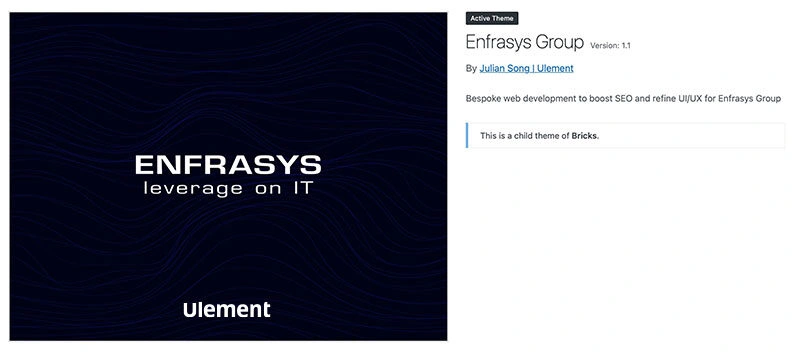
Why this works:
- Authorship is documented where developers and auditors expect it
- No impact on your public‑facing branding or SEO
The “Intellectual Property Copyright Excuse”: Why It’s a Myth, Not a Legal Barrier
You may have heard some agencies claim, “We can’t give you full access or transfer your website, it’s a copyright issue.” Let’s be absolutely clear: in almost every standard web project arrangement, this claim is misleading and often used to retain control, not protect genuine legal rights.
Fact Check: Copyright and Website Ownership
- For bespoke, commissioned work, the client (your business) is typically the rightful copyright owner or at minimum, you should have full, unlimited rights to use and control the website.
- Unless an agency is explicitly licensing you a product with ongoing restrictions (rare for bespoke builds), code, design, and content created specifically for you should be transferred, with all admin and access rights, upon final payment.
- If the site uses open source software (like WordPress, Bricks, plugins), those components remain under their original open source licence, but your custom content and design belong to you.
Why Agencies Make This Claim
- To maintain leverage, force extra payments, or keep the client dependent.
- To mask poor documentation or technical debt in the handover process.
- Sometimes out of confusion or ignorance, not actual legal risk.
Legal Advice: What Should a Client Do?
Review Your Contract Before Starting
- Ensure it states all deliverables (site code, content, admin access) become your exclusive property after final payment.
- Avoid vague terms like “we retain ownership” insist on clear transfer of rights for bespoke work.
If Facing Copyright Excuses After Completion
- Request a written explanation from the agency detailing what, specifically, they claim is protected.
- Remind the agency that unless agreed otherwise, standard practice and Malaysian law (and most international jurisdictions) recognise your right to the website you’ve paid for, especially if you supplied the content, vision, and paid for the build.
- Seek legal advice: A qualified Intellectual Property lawyer can review your contract and correspondence and often send a simple letter to resolve the matter quickly.
When in Doubt, Get Legal Help
- If an agency refuses to release your website after full payment, consult a technology or IP-focused solicitor.
- In almost all client-vs-agency disputes, particularly in bespoke or branded projects, the law supports the business owner’s right to access, use, and modify their own website.
The “copyright issue” defence is almost always a sign of an agency looking to keep you hostage, not protect actual legal rights. Professional web developers solve copyright questions up front, with clear agreements and transparent handovers. Never let “copyright” be used as an excuse to deny you full ownership and control.
Expert Advice for Agencies: Ethical and Effective Website Credit Practices
As website experts, we strongly recommend agencies adopt transparent, ethical credit practices that respect client ownership and promote long-term trust. Instead of defaulting to permanent footer credits, agencies should consider these professional recommendations:
Our Recommendations to Fellow Agencies:
- Obtain explicit client permission for any visible credit placements, ensuring clients understand and agree to the format and visibility level before launch.
- Create a dedicated “Credits” or “Acknowledgements” misc page on the client’s website where you list your company, team members, and partners. This keeps the footer clean whilst allowing proper recognition and client brand prominence.
- Avoid footer links that divert SEO value away from the client’s site. If linking is essential, use nofollow attributes or place links on the misc credit page instead of the footer.
- Position your credit as subtle, professional acknowledgement rather than aggressive advertising. Remember, your reputation grows when your clients’ branding shines brightly.
- Focus on portfolio and testimonials for your own marketing rather than relying on client footer links for promotion.
Why Ethical Crediting Benefits Everyone:
- Builds genuine trust with clients who appreciate transparency
- Respects client ownership and professional branding needs
- Supports long-term partnerships based on mutual respect
- Aligns with modern SEO best practices and entity trust principles
- Demonstrates professionalism that attracts quality clients
Ethical crediting isn’t just about being “nice”, it’s about building sustainable business relationships that benefit everyone. When clients succeed and feel respected, agencies naturally receive better referrals, testimonials, and long-term partnerships.
By following these principles, agencies can build transparent, trustworthy relationships whilst reinforcing client ownership, supporting the broader SEO and entity trust principles that companies must uphold in today’s digital landscape.
FAQ
Building Trust Through Transparency
“A website is a client’s business asset, not a hostage. Real ownership and transparent authorship build trust with both customers and search engines. Every business deserves complete control over their digital presence, no exceptions, no excuses.
In my experience helping Malaysian businesses recover from agency lock-in situations, the cost of regaining control always exceeds the investment in choosing transparent web agency partners from the start. Most business owners don’t realise the full implications until they face a crisis.”
Ready for a Transparent Website Partnership?
Don’t wait for problems to arise. Like many successful businesses, you can take control of your digital future with confidence through our transparent, ownership-first approach.
What We Guarantee:
- Complete ownership documentation from day one
- Full admin access with no restrictions
- Transparent contracts with clear handover terms
- Ongoing support that respects your independence
You’re likely to benefit from understanding exactly what you’re getting—and what you’re not getting, from your web development partner. Get a free website ownership audit or consultation today, and secure your business’s digital foundation.