Based on 18 years of website development experience, we define a website revamp as a strategic process. It rebuilds your site’s tech, user experience, and brand to match new business goals.
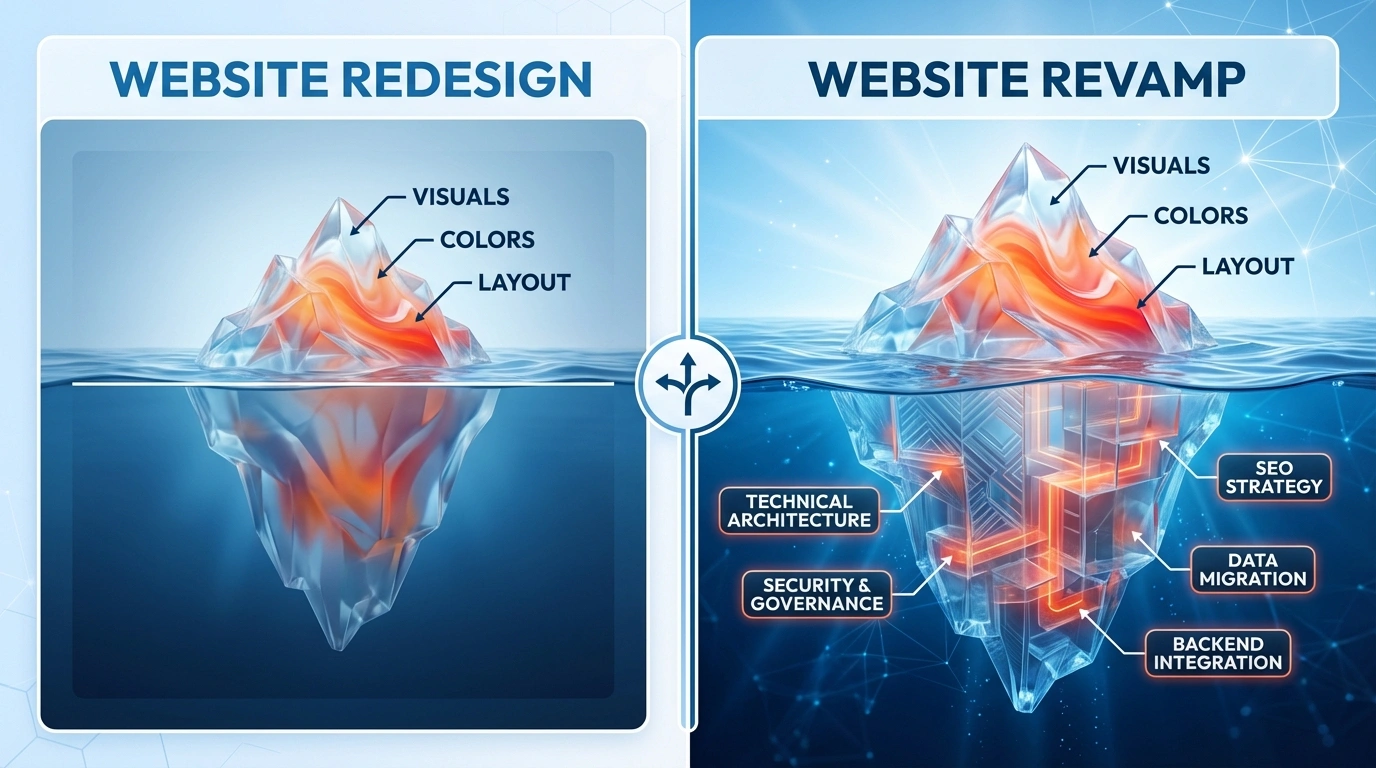
A revamp goes beyond looks. It fixes core infrastructure, compliance, and conversion tools. For Malaysian GLCs, PLCs, and enterprises, it aligns digital assets with governance, investor relations, and national agendas.
Note: Many organisations mistake a “redesign” for a “revamp.” A redesign changes how it looks; a revamp changes how it works, performs, and converts.
What Is a Website Revamp (vs Redesign or Refresh)?
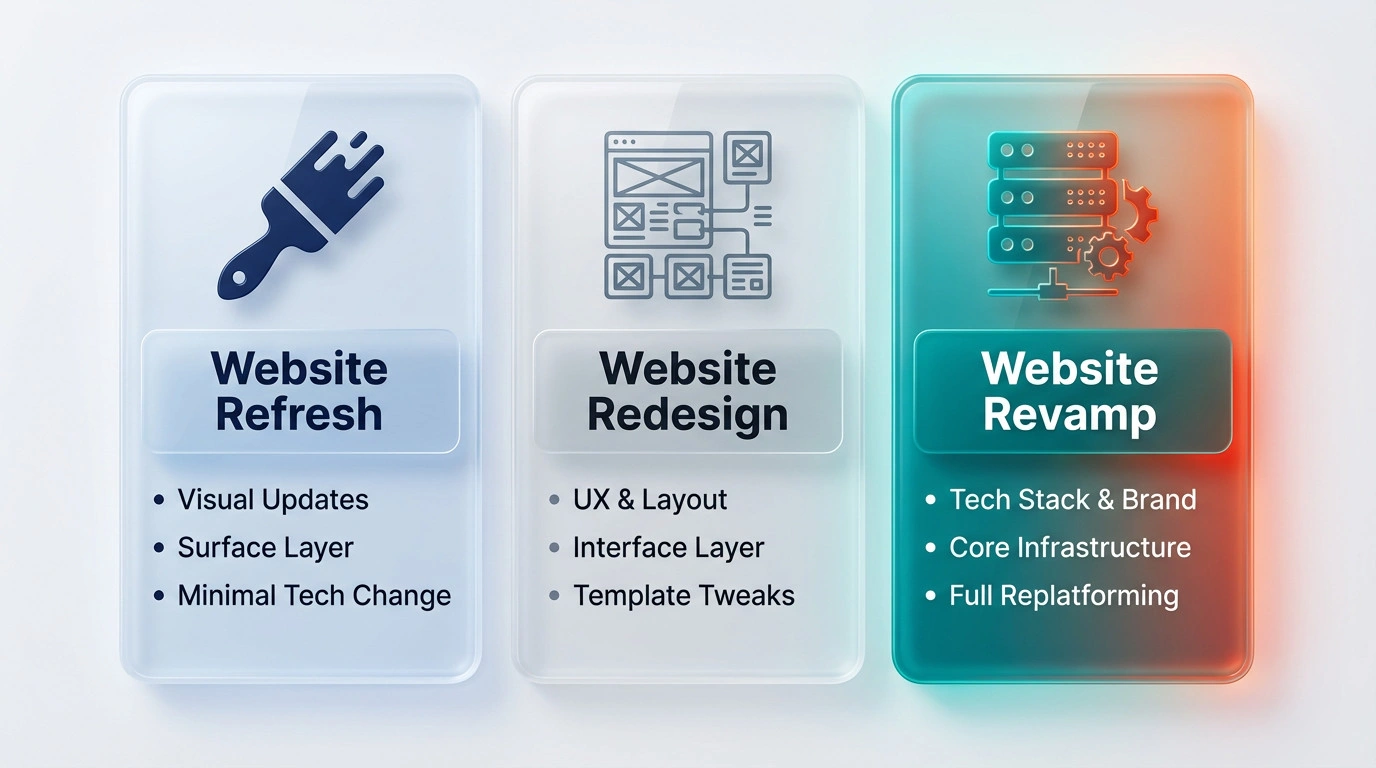
A website revamp is a holistic overhaul that integrates backend reengineering with frontend rebranding to solve fundamental performance and positioning issues. While a refresh touches surface elements, a revamp rebuilds the engine.
Comparison: Scope, Risk, and Impact
|
Feature |
Website Refresh |
Website Redesign |
Website Revamp |
|---|---|---|---|
|
Primary Focus |
Visuals & Content Updates |
UX & Layout Changes |
Tech Stack, Brand & Structure |
|
Depth |
Surface Layer (Skin) |
Interface Layer (Body) |
Core Infrastructure (Soul) |
|
Tech Change |
None / Minimal |
Minor Template Tweaks |
Full Replatforming / Reengineering |
|
Target Audience |
Existing Visitors |
User Engagement |
New Markets, Investors & Regulators |
|
Suitability |
SMEs with good tech |
Brands with UX issues |
Enterprises, GLCs, PLCs |
Signs Your Organisation Requires a Full Website Revamp
Legacy infrastructure often signals the need for a revamp before visual issues do. If your digital platform prevents marketing teams from launching campaigns without IT intervention, the architecture is obsolete.
Your Website No Longer Matches the Business Model
Organisations evolve faster than their digital footprints. PLCs and GLCs often expand into new sectors or adopt new ESG frameworks that old site structures cannot support. If the navigation hierarchy excludes profitable business units, the site actively harms revenue.
Low Conversion Rates Despite High Traffic
Traffic without conversion indicates a disconnect between user intent and site architecture. Enterprises frequently suffer from “content silos” where qualified leads land on pages with no clear conversion path. A revamp restructures these journeys to force alignment between traffic sources and business goals.
Outdated Technology and Security Risks
Technical debt is a silent killer. Slow load times, failing Core Web Vitals, and security vulnerabilities (common in unmaintained WordPress or Drupal instances) threaten data integrity. For regulated industries, failure to meet modern security standards is a governance violation, not just a tech issue.
Why a Website Revamp Is Both Reengineering and Rebranding
A successful website revamp is a dual-process integration of backend performance and frontend positioning. It treats the technology stack and the brand narrative as inseparable drivers of business growth.
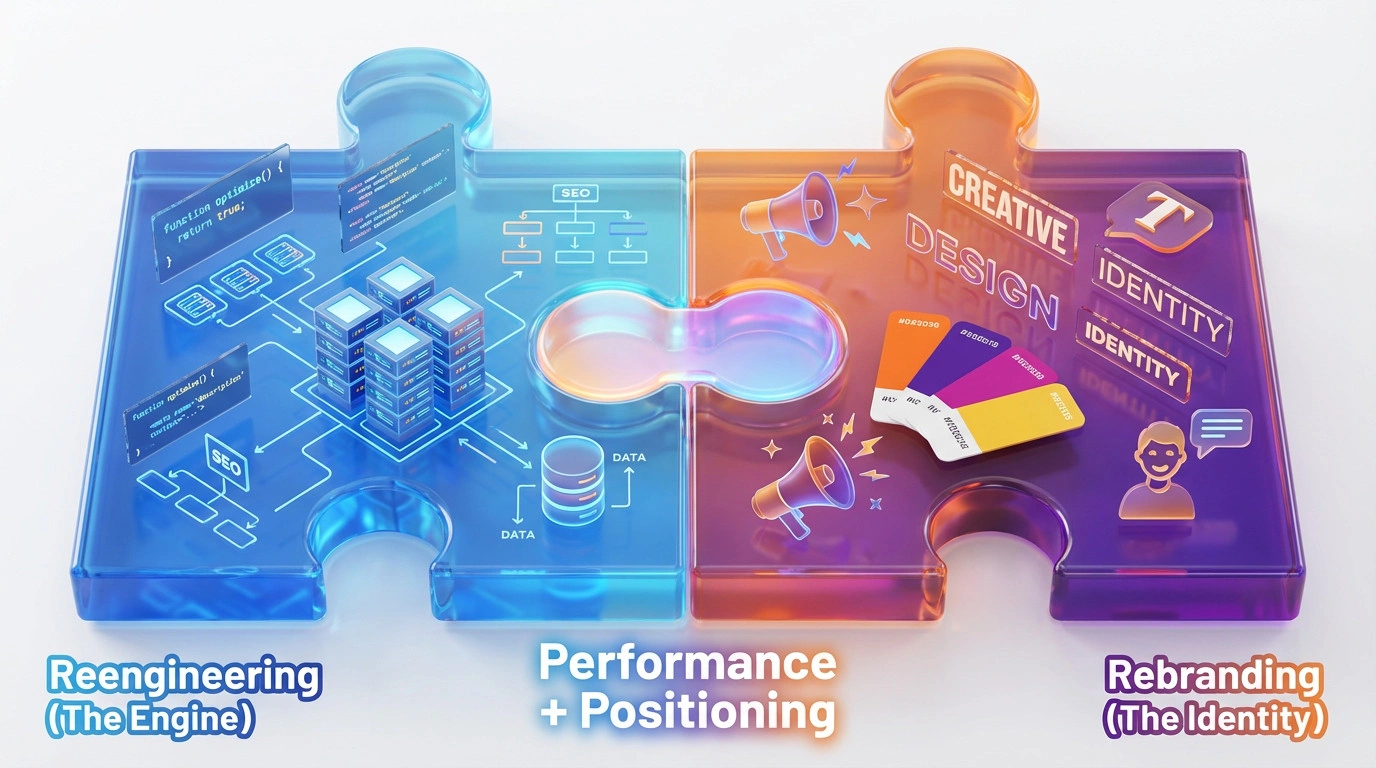
Reengineering: Fixing the Engine Under the Hood
Technical Reengineering is the structural overhaul of a website’s code, server environment, and database to maximise scalability and security. A true revamp requires more than new templates; it demands a solid Technical SEO Architecture that maps your entire entity structure before a single line of code is written.
- CMS Migration: Moving from legacy systems to headless architectures or enterprise-grade WordPress to improve speed.
- Integrations: Connecting critical business tools, CRMs (Salesforce, HubSpot), HR portals, and procurement systems, directly into the web interface.
- Governance: Implementing role-based access control (RBAC). This allows GLC/PLC teams to manage sensitive content securely without risking site integrity.
Rebranding: Aligning Messaging and Visuals
Corporate Rebranding is the strategic alignment of visual identity and market positioning to build stakeholder trust. Rebranding is not just a visual update; it is about building a Digital Twin architecture that mirrors your business value in a way search engines can understand.
- Visual Identity: Updating logos, typography, and colour palettes to meet digital-first accessibility standards (WCAG).
- Tone of Voice: Shifting from passive corporate speak to active, value-driven language that converts.
- Investor Relations: For PLCs, this requires presenting financial data and leadership vision with absolute transparency and authority.
The Website Revamp Process: From Audit to Launch
A structured roadmap mitigates risk and ensures stakeholder alignment. For GLCs and PLCs, this process must account for procurement cycles, board approvals, and strict governance standards.
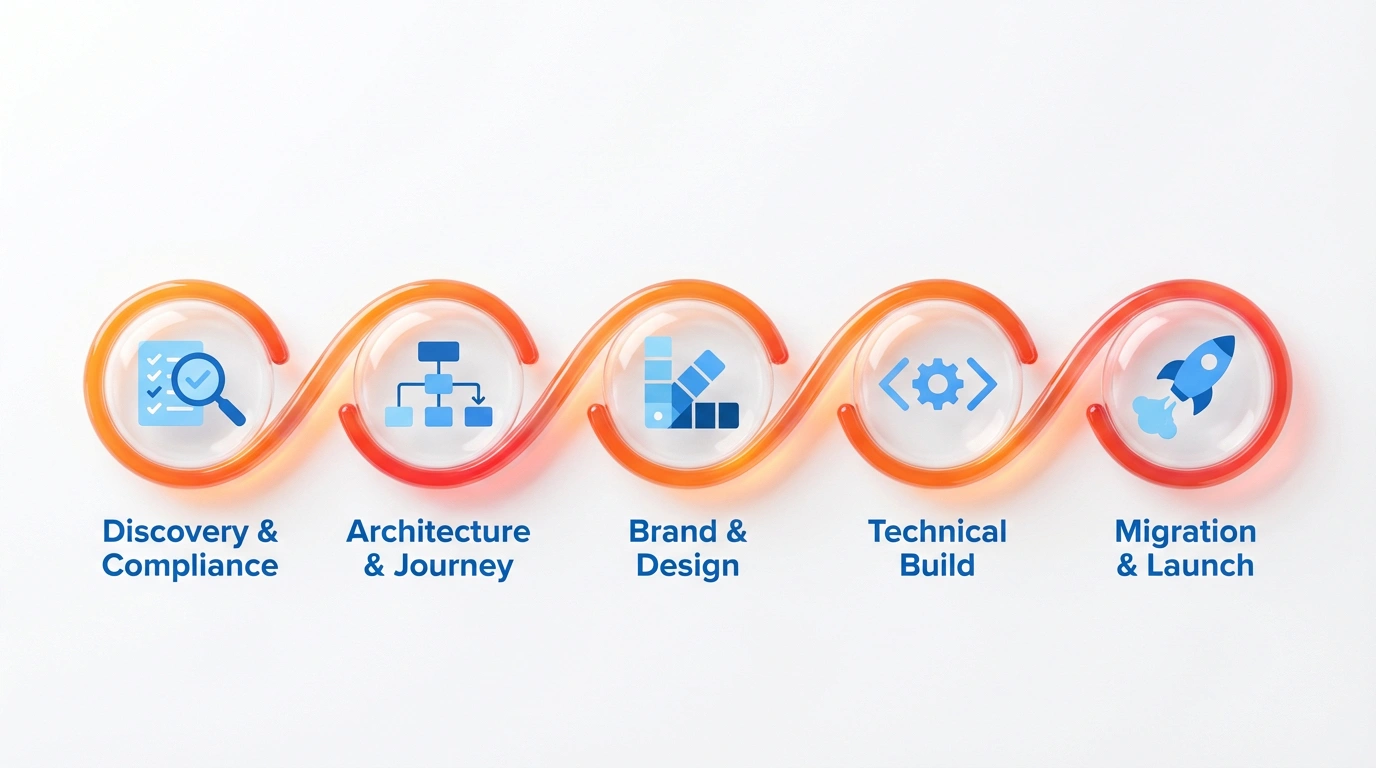
Step 1: Discovery & Compliance Strategy
Stakeholder interviews define success. We engage IT, Corporate Comms, Investor Relations, and Compliance teams early to align business goals.
Strategic Requirement: This phase is where the Technical SEO Architect defines the foundation of the project, ensuring that the new site structure supports long-term organic growth and isn’t just a visual facade.
Step 2: Architecture & User Journey Mapping
Information Architecture (IA) determines how users (and search bots) find information. We map distinct journeys for investors, job seekers, regulators, and customers.
Action: We move beyond basic sitemaps to design a comprehensive Technical SEO Architecture. This blueprint ensures every page has a clear semantic purpose and authority flow, preventing the “content silos” that plague many enterprise sites.
Step 3: Brand Positioning & Design System
Design systems ensure consistency. We create modular component libraries that allow teams to build new pages that remain brand-compliant. This is crucial for large organisations with decentralised content teams who need to move fast without breaking the layout.
Step 4: Technical Build & Integration
Development focuses on security, speed, and scalability. We set up staging environments, configure firewalls, and build API connections for third-party tools (Bursa Malaysia feeds, ATS, ERPs).
Note: Implementation is strictly guided by the specifications laid out in the discovery phase to prevent “scope creep” and technical debt.
Step 5: Content Migration & SEO Protection
Data migration is often the most time-consuming phase. We automate the transfer of thousands of legacy articles and press releases while manually rewriting core conversion pages to match the new intent-based structure.
SEO, Analytics, and Conversion: Protecting Traffic
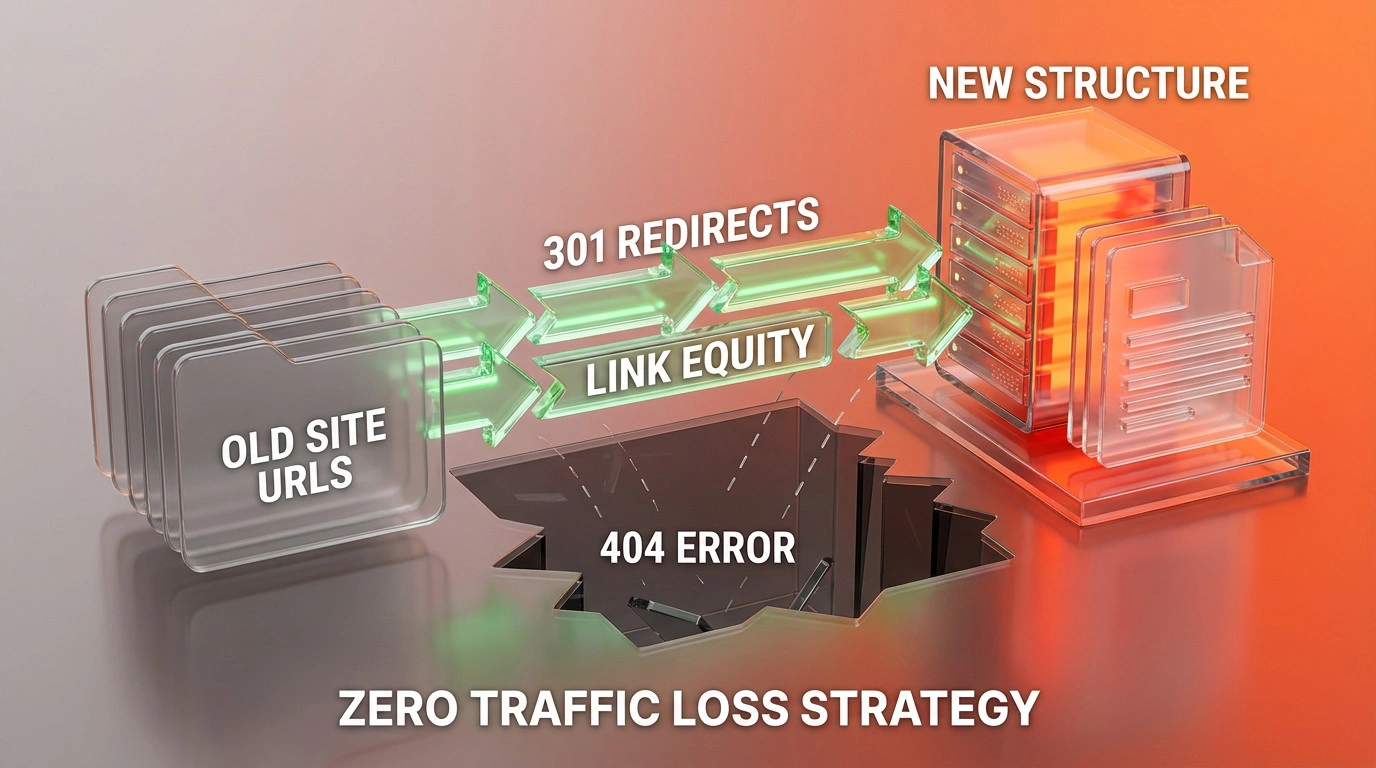
Organic traffic drops are the biggest risk during a revamp. Without a 301 redirect strategy, years of search equity can vanish overnight.
Minimising SEO Risk
Redirect mapping is non-negotiable. We crawl the old site to identify every live URL and map it to its new destination. For enterprises, this often involves tens of thousands of links. We also update XML sitemaps immediately upon launch to force faster indexing.
Conversion Optimisation (CRO)
Conversion points must be explicit. We replace generic “Contact Us” forms with segment-specific actions: “Request RFP,” “Investor Enquiry,” or “Media Kit Download.”
Timeline and Budget: What to Expect
For Malaysian GLCs, budget must also account for Multilingual Website Development to meet national language requirements without breaking the user experience. Project duration correlates with complexity, not just page count.
- SME Revamp: 8–12 weeks.
- Enterprise / GLC Revamp: 4–9 months.
Key Cost Drivers
- Security & Compliance Cycles:
- Multiple Rounds of Penetration Testing (Pen Test): Budget for at least three phases: Initial Audit → Remediation (Fixing) → Verification Scan.
- Third-Party Validation: For financial PLCs or critical infrastructure GLCs, costs must include external security consultants to validate the architecture before “Go Live.”
- Data Migration Scope:
- Volume & Integrity: Moving 10,000+ nodes (historical annual reports, press releases, investor data) versus 50 marketing pages.
- Mapping: The cost of granular 301 redirect mapping to ensure no 404 errors occur on legacy URLs.
- Stakeholder Management & Reviews:
- Iterative Design Reviews: Unlike SMEs, enterprises often require 3–4 rounds of design approval (Working Group → Steering Committee → Board Level).
- Multi-Department UAT: Coordinating User Acceptance Testing (UAT) across IT, Comms, Legal, and HR. The cost lies in the time required to collate, process, and implement feedback from these distinct silos.
Insight: View the budget as CapEx (Capital Expenditure) for digital infrastructure, not just OpEx (Operating Expense) for marketing.
Common Mistakes in Enterprise Website Revamps
Organisational friction and strategic misalignment often derail projects more than technical failure.
- The “Skin-Deep” Trap (Just a New Outlook):
- Mistake: Many organisations merely replace the visual theme (“new outlook”) without reengineering the core architecture.
- Consequence: This cosmetic approach fails to improve User Experience (UX), Core Web Vitals (Performance), or SGE Readiness. Worst of all, changing the interface without mapping the underlying URL structure often leads to immediate and severe organic traffic loss.
- Ignoring Internal Stakeholders:
- Mistake: Launching without input from HR, Investor Relations, or Compliance.
- Consequence: Leads to immediate post-launch change requests and “scope creep” that bloats the budget.
- Underestimating Content Effort:
- Mistake: Assuming content migration is a “copy-paste” job.
- Consequence: Writing unique value propositions for 50+ business units takes months. Rushed content results in thin pages that fail to rank in AI search results.
- Neglecting Post-Launch Governance:
- Mistake: Delivering a powerful new platform without a user manual or role-based training.
- Consequence: The site “breaks” or degrades within a year as untrained staff upload unoptimised images and break formatting standards.
Case Snapshot: Transforming a Regulated Entity
Client: A prominent Malaysian organisation in the infrastructure sector.
Challenge: A 10-year-old site that failed security audits and confused investors.
Solution:
- Reengineering: Migrated to a secure enterprise cloud host with automated backups.
- Rebranding: Aligned digital identity with the new 5-year strategic blueprint.
- Governance: Implemented workflows where content requires Legal approval before publishing.
- Result: 40% increase in qualified vendor registrations and zero security incidents in 12 months.
Next Step
Are you planning a strategic overhaul for your organisation? Ulement can conduct a preliminary Digital Infrastructure & Brand Audit to identify your current technical gaps and opportunities. This audit specifically addresses the governance and performance needs of Malaysian GLCs, PLCs, and enterprises.
Ready to turn your legacy site into a growth engine? Explore our enterprise website redesign services or book a preliminary audit today.