Business owners frequently treat website code as a passive delivery layer for visual design. Assuming code functions properly simply because a site looks correct on a screen creates a structural liability in the era of AI Search and Large Language Models (LLMs). Ulement helps modern enterprises navigate this shift, moving digital strategies from a web built for human eyes to a web optimised for machine extraction.
AI systems like Google Gemini, OpenAI models, Perplexity, or Bing Copilot do not see typography, animations, or branded colour palettes when looking for answers. Search algorithms read the raw structural language of a site: the HTML. Flawed structures render corporate data invisible.
Semantic HTML acts as the critical bridge between corporate data and the algorithms that now decide whether a brand is seen, cited, and trusted.
Defining the Basics: What Is Semantic HTML?
Semantic HTML describes the practice of writing code that defines the meaning and role of content rather than just its appearance. The methodology introduces a vocabulary that tells a machine exactly what a block of text represents within the broader context of the page.
Developers writing semantic HTML use elements like <header>, <main>, <article>, <section>, <nav>, and <footer> to define structure and intent, while CSS handles all visual styling. Strict separation allows search engines, accessibility tools, and LLMs to understand the page as a hierarchy of entities and relationships instead of a pile of styled text.
What Is the Difference Between Semantic and Non-Semantic Markup?
Non-semantic tags like <div> and <span> function as generic containers. Generic containers tell the browser nothing about the purpose of their contents because they simply provide hooks for layout and styling. Developers writing basic layouts might use:
HTML
<div class="nav">...</div>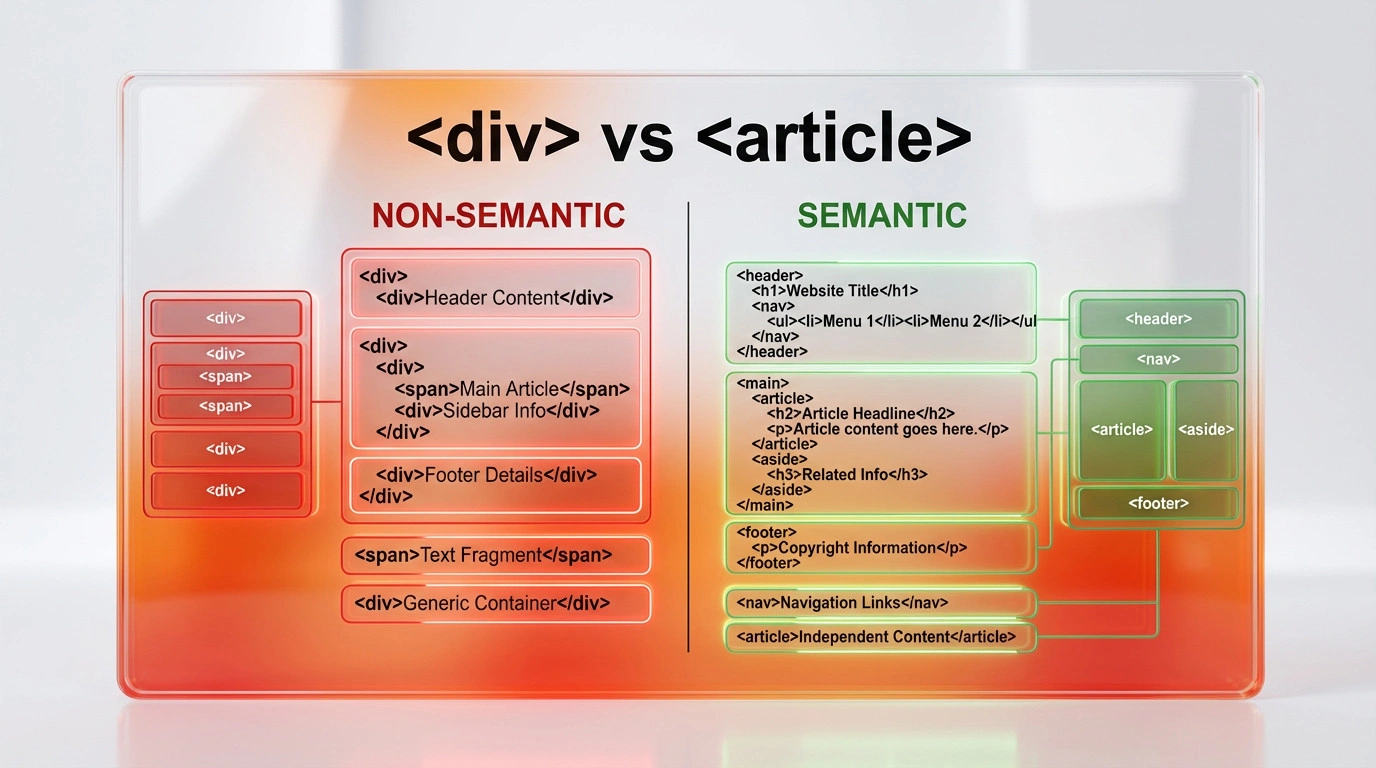
Visual outputs can look identical when comparing generic markup to semantic tags like <nav>...</nav>.
AI crawlers and screen readers experience a profound difference. The <nav> element explicitly declares that the block contains site navigation. The <article> tag signals a self-contained piece of content. Semantic tags encode intent, allowing machines to interpret page hierarchy without guessing.
Why Are Old-School HTML Tags No Longer Enough?
Early web design relied on tags like <b> and <i> to control visual emphasis only. Presentation tags made text bold or italic but carried no information about why the text mattered. Modern CSS is responsible for visual presentation, leaving HTML to express strict structure and meaning.+1
Relying on generic <div> containers produces a deep, tangled DOM with no semantic landmarks known as “div soup”. AI crawlers and assistive technologies must infer layout intent in this environment. Guesswork directly harms brand visibility in AI search experiences and rich result surfaces.
Deep Dive: Why Does Semantic HTML Matter for AI and LLMs?
Traditional SEO optimised for keyword density, on-page signals, and backlinks. AI-era SEO, often called Answer Engine Optimisation (AEO) or Generative Engine Optimisation (GEO), optimises for data extraction and reasoning. Brands wanting citation inside AI Overviews must provide a structure machines can parse without friction.
How Do Large Language Models Parse Web Content?
Large Language Models do not view a site visually. AI models operate under token budgets and process HTML as structured text. AI crawlers fetch a page, pull the DOM and Accessibility Tree, and segment content into blocks for indexing and summarisation.
Bloated DOMs filled with thousands of meaningless <div> elements force the model to burn compute just to identify the main content boundaries. Clear semantic landmarks eliminate guesswork and make content cheap to process.
How Does Semantic Structure Provide Context for RAG?
Retrieval-Augmented Generation (RAG) powers most modern AI search experiences. RAG systems retrieve relevant chunks from a vector index of content and use them as factual grounding before generating an answer.
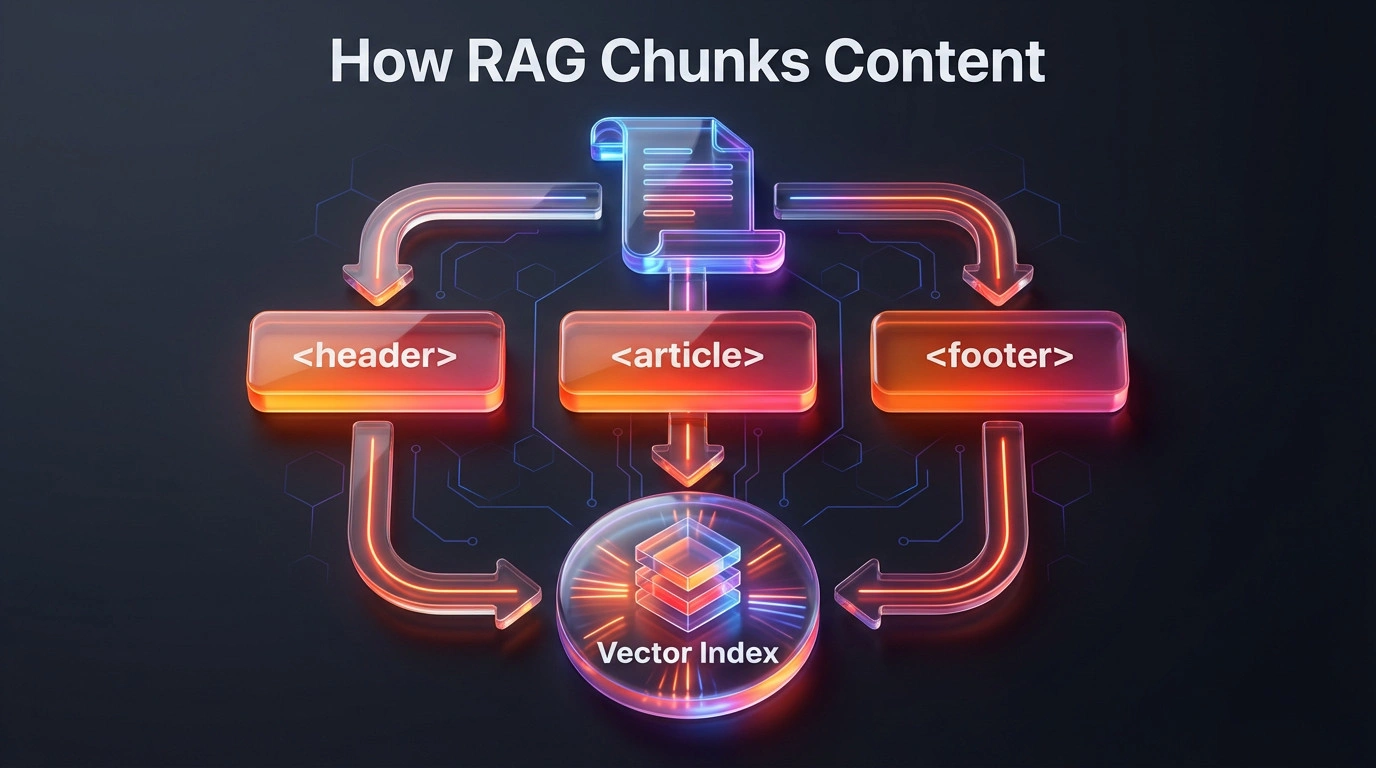
RAG pipelines work best when source documents feature explicit structural boundaries. Semantic HTML gives RAG systems natural chunking units:
<article>provides self-contained documents for extraction.<section>identifies topic-specific segments within an article.<aside>marks supporting, non-core information.<nav>and<footer>flag structural elements to ignore for answer extraction.
How Can Clear Hierarchy Reduce AI Hallucinations?
AI hallucinations frequently arise from weak or ambiguous context. Pages wrapping the main article, author biography, and advertisements inside indistinguishable <div> blocks confuse LLMs, causing blended narratives.
Separated layouts give the model distinct, labelled segments to reason over. Correct structuring paired with structured data reduces misattribution and helps AI cite content accurately and consistently.
What Is HTML’s Role in Voice Search and Conversational Agents?
Voice assistants face stricter constraints than traditional search because devices must pick one answer to read aloud. Conversational agents cannot safely serve a noisy list of links.
Semantic HTML supports voice search by marking short facts with definition-style sections. Adding Speakable schema to specific <section> elements further signals to Google Assistant that the enclosed text is explicitly formatted for audio playback, dramatically increasing the chances of voice capture.
Which Key Semantic Elements Do AI Agents Prioritise?
Building a resilient digital twin of a business requires the right HTML vocabulary.
How Do Content Sectioning Tags Work?
Sectioning elements define the macro-structure of documents.
<main>: The primary content area of the page. Developers should use only one per page, excluding headers, footers, sidebars, and navigation.<article>: A self-contained unit such as a blog post or case study that can stand on its own.<section>: A thematically related block within an article, usually introduced by a heading.<nav>: A group of navigational links instructing crawlers to treat the block as infrastructure instead of body copy.
Macro-structure landmarks help search engines and LLMs identify core content quickly.
What Is the Purpose of Contextual Wrappers?
Contextual elements separate core content from support structures.
<header>: Introductory content for the page or section, usually including the main heading.<footer>: Metadata and links at the end of an article, such as author details and legal information.<aside>: Content related to but not central to the main flow, like glossary boxes or promos.
AI systems use contextual signalling to safely down-weight <aside> content during summarisation.
How Should Data Definition Tags Be Used?
Data definition elements enable explicit data extraction.
<figure>+<figcaption>: Couples an image or chart with its description so multimodal models link visual content to correct text.<time datetime="2026-02-21">: Supplies machine-readable dates while keeping human-friendly display text.<table>: Represents tabular data, allowing AI to reconstruct relationships between rows and columns with high precision.
Why Is Heading Hierarchy Critical for AI Summarisation?
Heading tags define the logical outline of a document rather than simply sizing text. AI crawlers create internal table-of-contents structures from headings before reading body copy.
Best practices include:
- Using one
<h1>per page to declare the primary topic. - Using
<h2>for major sections and<h3>for subsections in order. - Avoiding skipped levels without an intervening level.
- Writing descriptive, entity-rich headings matching natural language queries.
Where Do Accessibility, SEO, and AI Intersect?
Solid code structure solves multiple problems simultaneously. Markup optimising for AI also underpins accessibility compliance.
How Do Assistive Tech and AI Share the Same Accessibility Tree?
Browsers build three models when parsing a page: the DOM, the CSSOM, and the Accessibility Tree. Screen readers traverse the Accessibility Tree instead of visual layouts.
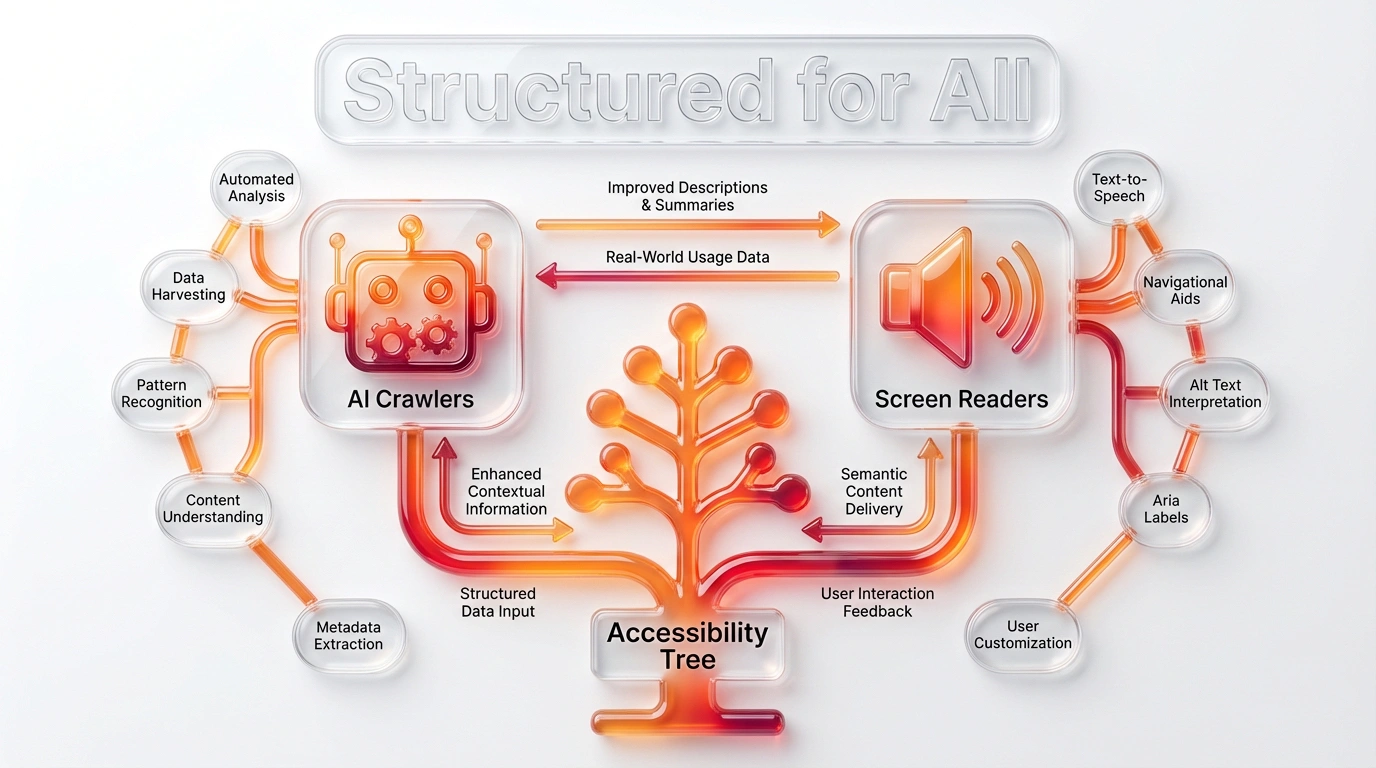
AI crawlers rely on the exact same structural signals, including landmarks and proper heading nesting. Accessibility and AI comprehension represent aligned incentives.
How Has Indexing Evolved From Search Engines to Answer Engines?
Classic search engines indexed documents primarily using keywords. Modern AI experiences index entities, such as people, brands, products, and concepts.
Semantic HTML provides clear boundaries for entity descriptions. Proper code architecture transforms websites from loose collections of pages into structured data assets.
Practical Guide: How Can Code Be Refactored for AI Visibility?
Transforming a visually acceptable site into a machine-readable entity requires deliberate refactoring. Engineering teams must replace div soup with clean landmarks.
How Do Developers Fix the “Div Soup” Problem?
Drag-and-drop builders often wrap elements in nested containers, creating “div soup”. Bloated DOMs obscure main content and mix navigation with ads.
AI crawlers view bloated code as a signal-to-noise problem. High extraction costs cause crawlers to deprioritise heavily nested pages in favour of cleaner sources.
What Does Code Look Like Before and After Semantic Refactoring?
Typical blog headers demonstrate this shift clearly.
Broken, non-semantic approach:
HTML
<div class="header-container">
  <div class="post-title">Understanding AI</div>
  <div class="post-date">October 12, 2024</div>
</div>
Semantic, AI-optimised approach:
HTML
<header>
  <h1>Understanding AI</h1>
  <time datetime="2024-10-12">October 12, 2024</time>
</header>
Visual rendering remains identical, but the semantic version removes crawler guesswork entirely.
How Can WordPress and Page Builders Output Semantic Code?
Most WordPress visual builders generate significant DOM bloat by default. Engineering these development tools correctly prevents non-semantic markup from polluting the site architecture.
Developers must use native HTML5 widgets, avoid nested sections used solely for spacing, and audit rendered HTML directly in the browser rather than relying on the visual canvas.
Ulement actively avoids structural bloat by developing platforms with Bricks Builder. Bricks Builder natively produces clean code with correct semantic markup right out of the box.
Developing with structural precision ensures the final HTML output remains highly legible to AI crawlers and search engines without requiring constant retroactive cleanup.
How Does Structured Data (Schema.org) Integrate With Semantic HTML?
Semantic HTML defines structure, whereas Schema.org markup defines entities and relationships. Integrating both makes brands completely machine-readable.
Google strongly recommends JSON-LD for structured data. Ulement implements advanced schema to ensure robust entity attribution, explicitly tying content blocks to corporate identities:
HTML
<script type="application/ld+json">
{
  "@context": "https://schema.org",
  "@type": "Article",
  "@id": "https://u.msia.dev/what-is-semantic-html/#article",
  "mainEntityOfPage": "https://u.msia.dev/what-is-semantic-html/",
  "headline": "What Is Semantic HTML, Why It Matters for SEO & AI",
  "datePublished": "2026-02-21",
  "author": {
    "@type": "Organization",
    "name": "Ulement"
  },
  "publisher": {
    "@type": "Organization",
    "name": "Ulement",
    "logo": {
      "@type": "ImageObject",
      "url": "https://u.msia.dev/wp-content/uploads/2024/04/logo-ulement-blk.jpg"
    }
  }
}
</script>
Schema types must align closely with semantic blocks:
| Schema Type | Paired Semantic Element | Core Benefit |
Article | <article> | Clear authorship data for AI Overviews |
FAQPage | <section> containing FAQs | Higher eligibility for direct answers |
HowTo | Ordered lists within <article> | Step-by-step rich procedural results |
Speakable | <section id="audio-summary"> | Increased voice search extraction |
Future-Proofing Web Presence for the AI Era
Websites built purely for visual appeal operate as depreciating assets. User behaviour shifting toward AI chatbots and agentic assistants means corporate data must live inside architectures designed for automated extraction and reasoning.
Semantic HTML acts as the foundational vocabulary allowing clear communication with AI systems. Eliminating DOM bloat, implementing strict heading hierarchies, and layering Schema.org strategies transforms digital brochures into machine-readable knowledge bases. Relying on marketplace themes that bury content in generic containers renders brands invisible to next-generation search engines.
Ulement provides a comprehensive Site Audit & Analysis to surface hidden DOM bloat and broken hierarchies blocking AI visibility. Continuous Website Maintenance from Ulement ensures enterprise digital assets remain clean, fast, and fully legible to machines.