For years, the goal was simple: get your website to the top of Google. But as search engines have evolved into sophisticated, AI-powered “answer engines,” the definition of “visibility” has fundamentally changed. Your customers are now finding answers in snippets, voice assistants, and AI-generated summaries before they even click on a website.

The purpose of this guide is to demystify the new pillars of findability: traditional Search Engine Optimisation (SEO), Answer Engine Optimisation (AEO), and the critical new frontier, Generative Engine Optimisation (GEO). By the end, you will have an actionable framework for a truly holistic search strategy that will future-proof your business.
The Foundational Pillar: Why SEO Still Reigns Supreme
Before we dive into the new technologies, we must reinforce the foundation. Without strong, traditional SEO, any efforts in AEO or GEO will fail.

What is SEO? Unpacking the Core Mission
Search Engine Optimisation (SEO) is the foundational practice of improving your website to increase its visibility for relevant searches, with the primary goal of driving qualified organic traffic to your web properties. It’s about making your website technically sound, relevant to user queries, and authoritative in your field.
To use an analogy, SEO is like building the North-South Expressway to your digital storefront. It’s the essential infrastructure that allows a high volume of qualified customers to find you efficiently.
SEO in Action: From Informational to Transactional Intent
Informational Intent Keywords & Content Ideas:
This is where you build trust by answering questions.
- Target Keywords:
learn seo,latest seo trends,seo for beginners - Content in Action:
- Mini-Glossary of Core SEO Terms:
- On-Page SEO: Optimizing individual web pages (content, title tags, images).
- Off-Page SEO: Building authority through external signals (backlinks, brand mentions).
- Technical SEO: Ensuring your site can be crawled and indexed efficiently (site speed, mobile-friendliness, sitemaps).
- Checklist: Is Your Webpage SEO-Friendly?
- [ ] Does the title tag include the primary keyword?
- [ ] Is the content comprehensive and easy to read?
- [ ] Are images optimised with alt text?
- [ ] Does the page load in under 3 seconds?
- Further Reading: Link to our “Top 10 SEO Trends for 2025” article.
- Mini-Glossary of Core SEO Terms:
Commercial & Transactional Intent Keywords & Content Ideas:
This is where you convert trust into business.
- Target Keywords:
seo services malaysia,local seo company penang,ecommerce seo agency,hire seo expert - Content in Action:
- Comparison: When to Hire an SEO Agency vs. DIY
| Feature | DIY SEO | Hiring an Agency (like Ulement) | | :— | :— | :— |
| Cost | Low initial cost, high time investment. | Monthly investment, low time requirement. |
| Expertise | Requires constant learning. | Access to dedicated specialists & tools. |
| Speed | Slow, trial-and-error results. | Faster, more strategic implementation. |
| Best For | Very small budgets, hobby sites. | Businesses focused on growth & ROI. |
- Comparison: When to Hire an SEO Agency vs. DIY
- Checklist: Questions to Ask a Potential SEO Partner
- Can you show me case studies relevant to my industry in Malaysia?
- How do you measure and report on success?
- What is your approach to link building and content?
- Case Study Snippet:
“How we helped a local George Town bakery increase foot traffic by 60% through targeted Local SEO and Google Business Profile optimisation.”
The Direct Answer: Winning with Answer Engine Optimisation (AEO)
If SEO builds the highway, AEO creates the highly visible, instantly informative billboards along the way.
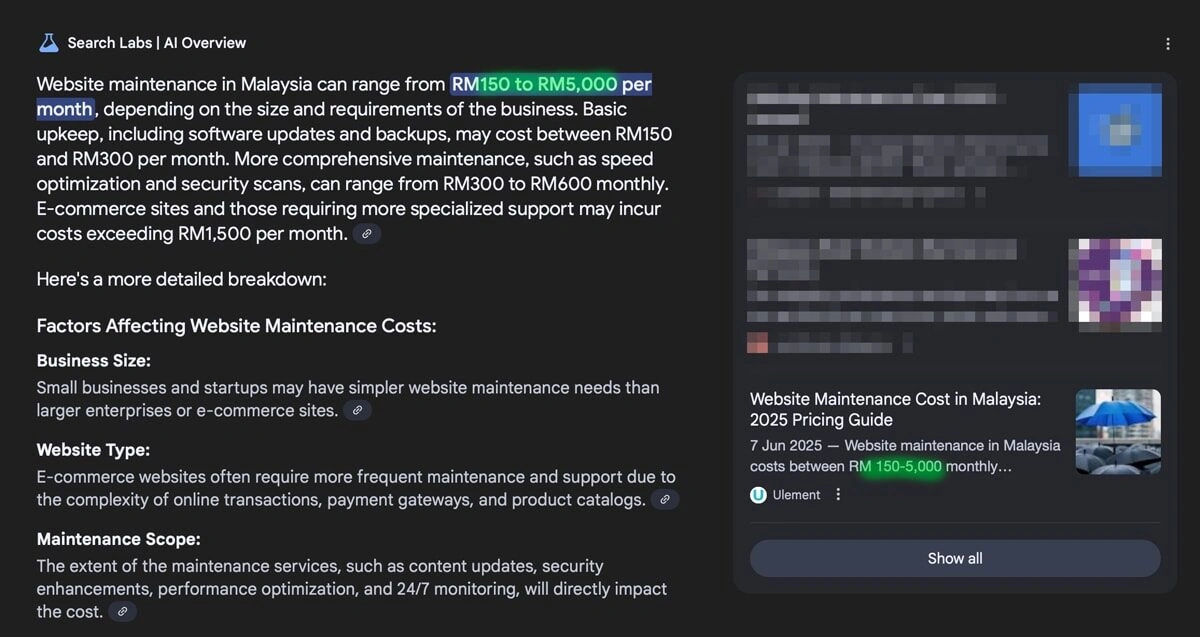
What is AEO? Optimising for Zero-Click & Voice Search
Answer Engine Optimisation (AEO) is the practice of structuring and formatting your content to be the direct, concise answer on Search Engine Results Pages (SERPs) and for voice assistants. This includes targeting Featured Snippets, People Also Ask boxes, and voice replies from Alexa, Siri, and Google Assistant.
Its goal is to capture immediate user attention in “zero-click” scenarios, where the user gets their answer without ever visiting a website. It establishes your authority by positioning you as the source of truth. The analogy I use is: AEO is like being the expert that the librarian (Google) quotes directly to the person asking the question.
AEO in Action: The Tactics of Being the Definitive Answer
Informational Intent Keywords & Content Ideas:
- Target Keywords:
how to get into featured snippets,what are "people also ask" boxes - Content in Action:
- Visual Breakdown of SERP Features:
- (Image: Mockup of a Featured Snippet) Featured Snippet: The box at the top of the results with a direct answer. You win this with a clear, concise paragraph, list, or table.
- (Image: Mockup of a PAA box) People Also Ask (PAA): An accordion-style box of related questions. Answering these questions directly in your content can get you featured here.
- (Image: Mockup of a Knowledge Panel) Knowledge Panel: The panel on the right side of the desktop SERP, usually for well-known entities (like your brand).
- The “Why” Behind These Features: Google’s primary goal is user satisfaction. Providing direct answers keeps users on Google and satisfies their query faster, which is a better user experience.
- Visual Breakdown of SERP Features:
Action-Oriented Intent Keywords & Content Ideas:
- Target Keywords:
schema markup for faqs,how to rank for question keywords,voice search seo strategy - Content in Action:
- Guide: How to Find Question-Based Keywords
- Go to a free tool like
AnswerThePublic. - Enter your core topic (e.g., “website maintenance”).
- The tool will generate hundreds of questions people are asking (“how much does website maintenance cost,” “why is website maintenance important”).
- Create content that directly answers these questions.
- Go to a free tool like
- Guide: How to Find Question-Based Keywords
- Template: Simple FAQ Schema (Copy-Paste)
<script type="application/ld+json">
{
  "@context": "https://schema.org",
  "@type": "FAQPage",
  "mainEntity": [{
    "@type": "Question",
    "name": "Your First Question Here?",
    "acceptedAnswer": {
      "@type": "Answer",
      "text": "Your clear, concise answer here."
    }
  },{
    "@type": "Question",
    "name": "Your Second Question Here?",
    "acceptedAnswer": {
      "@type": "Answer",
      "text": "Your second clear, concise answer here."
    }
  }]
}
</script>- Checklist: Voice Search Readiness
- [ ] Is your content written in a natural, conversational tone?
- [ ] Are answers to questions short and to the point (under 30 words)?
- [ ] Is your mobile site speed excellent?
- [ ] Have you claimed your Google Business Profile? (Crucial for “near me” voice searches).
The New Frontier: Getting Cited by AI with GEO
This is the next evolution. If AEO is being quoted by the librarian, GEO is having your work cited in the AI’s final research paper.

What is GEO? Securing Your Place in AI-Generated Results
Generative Engine Optimisation (GEO) is the advanced strategy of optimising your content and brand authority to influence and appear as a trusted, citable source in AI-powered search results, such as Google’s AI Overviews and chatbot responses (from ChatGPT, Gemini, etc.).
Its goal is to ensure your brand’s visibility, messaging, and expertise are part of the next wave of search. It’s about building such profound trust that AI models select your data and perspective to construct their answers. My favorite analogy is: GEO is like becoming a primary source in a research paper written by an AI. Many in the industry are now asking if GEO is the new SEO, fundamentally shifting how we approach findability.”
GEO in Action: Building the Authority AI Trusts
Informational Intent Keywords & Content Ideas:
- Target Keywords:
how ai overviews work,generative ai in marketing - Content in Action:
- The Core Concept: E-E-A-T For AI to trust you, you must demonstrate Experience, Expertise, Authoritativeness, and Trustworthiness. This is no longer just a concept; it’s the foundation of GEO.
- Experience: Show you’ve actually done what you’re talking about (case studies, first-hand accounts).
- Expertise: Showcase credentials and in-depth knowledge.
- Authoritativeness: Prove that others see you as a leader (backlinks, mentions, reviews).
- Trustworthiness: Be transparent and secure (clear contact info, secure website).
- Analysis of AI Overviews:
- (Image: Screenshot of a good AI Overview) Good Example: The AI cites 2-3 authoritative sources, provides a nuanced answer, and links out clearly.
- (Image: Screenshot of a bad AI Overview) Bad Example: The AI gives a simplistic or incorrect answer, citing low-quality forums or blogs. This happens when it can’t find enough authoritative sources. Your goal is to be the source it finds.
- The Core Concept: E-E-A-T For AI to trust you, you must demonstrate Experience, Expertise, Authoritativeness, and Trustworthiness. This is no longer just a concept; it’s the foundation of GEO.
Strategic & Commercial Intent Keywords & Content Ideas:
- Target Keywords:
how to get cited in ai overviews,geo strategy for law firms,ai-powered content optimisation - Content in Action:
- GEO Action Plan:
- Build a Robust Knowledge Graph: Use structured data (Schema) for your organization, authors, and services so AI can understand who you are.
- Signal Authoritativeness: Create detailed author pages with biographies and credentials. Actively seek citations and mentions in reputable industry publications.
- Publish Original Data & Research: Conduct your own surveys or analyze unique data. AI models are hungry for unique information they can’t find elsewhere. For example, “We analyzed 100 SME websites in Malaysia to find the most common security vulnerability.”
- Template: Crafting “Citable Sentences” Within your content, write clear, declarative sentences that are easy for an AI to lift and cite.
- Instead of: “It might be a good idea to think about your site speed.”
- Write: “According to our 2025 performance analysis, improving website speed by one second can increase conversions by up to 20% for Malaysian e-commerce sites.“
- GEO Action Plan:
SEO vs. GEO vs. AEO: Creating a Unified Strategy
These three disciplines are not separate; they are deeply interconnected parts of a modern search strategy.
How They Work Together: The Modern Search Flywheel
This section directly targets SEO vs GEO and SEO vs AEO keywords.
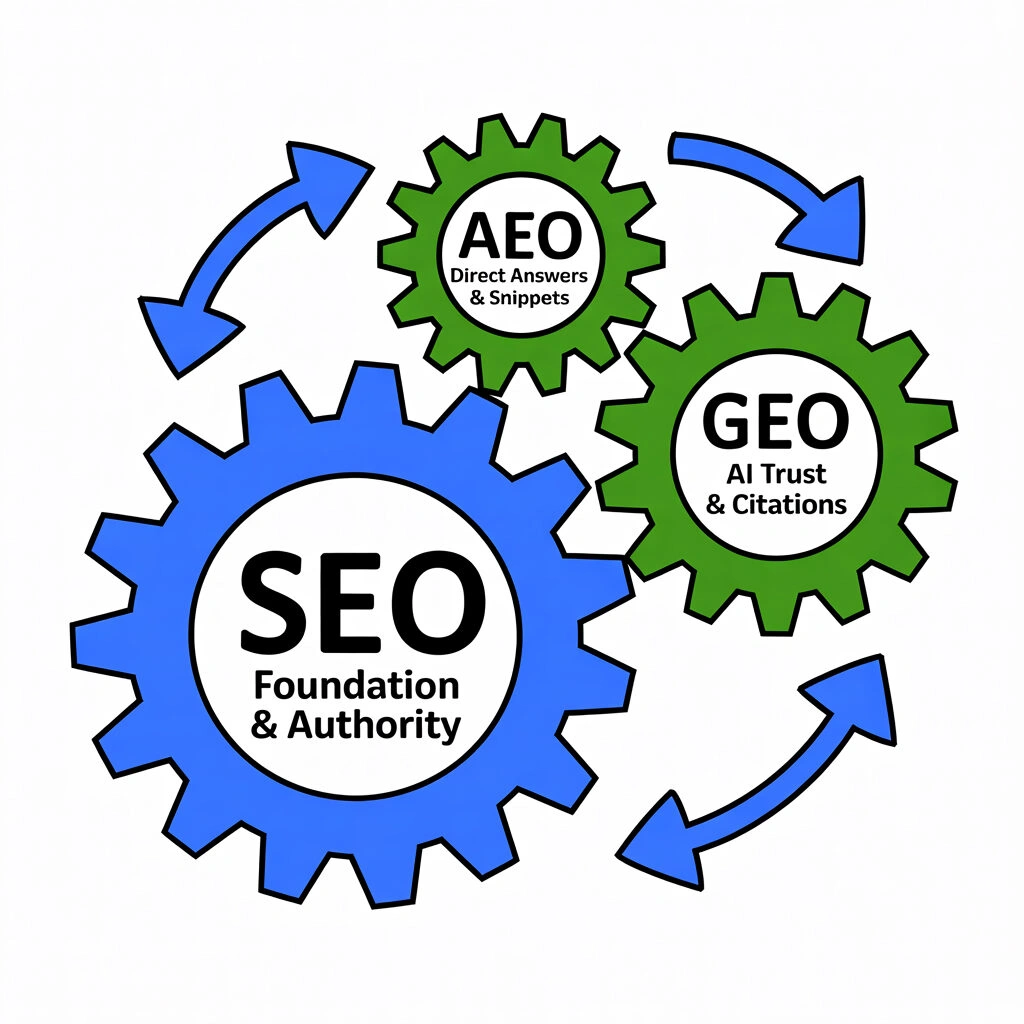
Imagine a flywheel. SEO is the heavy outer wheel; it takes effort to get moving, but it builds momentum and foundational domain authority. AEO is the gear that engages with that wheel; it uses the authority from SEO to capture specific, high-intent queries and deliver quick wins (like Featured Snippets). GEO is the power generator connected to the flywheel; it uses the combined signals of authority (from SEO) and expertise (proven by AEO) to establish a level of trust so profound that AI models cite you as a primary source. Each part makes the others stronger.
Summary Comparison Table:
| Feature | SEO (Search Engine Optimisation) | AEO (Answer Engine Optimisation) | GEO (Generative Engine Optimisation) |
|---|---|---|---|
| Primary Goal | Drive traffic by ranking high in search results. | Be the direct answer on Google and in voice search. | Become a citable source for AI Overviews & chatbots. |
| Core Question | “How do I become the best destination for a topic?” | “How do I answer a specific question perfectly?” | “How do I prove my content is trustworthy for an AI?” |
| Key Tactics | • Technical & On-Page SEO • Content Creation • Quality Link Building | • Q&A Content Structure • Use Lists & Tables • FAQ Schema Markup | • Build E-E-A-T signals • Publish Original Data • Prove Author Expertise |
| Where it Appears | Classic “blue link” search results. | • Featured Snippets • “People Also Ask” • Voice Assistant replies | • AI Overviews • Chatbot responses • As a cited source |
| Primary Audience | Search engine crawlers & algorithms. | The direct user asking a question. | AI language models and their data sets. |
| How to Measure | • Organic Traffic • Keyword Rankings • Domain Authority | • SERP Feature Ownership • Clicks from Rich Results • Voice Search Mentions | • Citations in AI Overviews • Brand Mentions by AI • Traffic from AI Results |
| Required Mindset | The Digital Architect. Building a strong foundation. | The Helpful Librarian. Providing fast, accurate answers. | The Expert Professor. Creating original, citable knowledge. |
| Penang Example | A cafe ranks #1 for “best coffee in George Town.” | Google Assistant answers “what time does the cafe open?“ | An AI Overview on coffee cites the cafe’s original research. |
Building Your Future-Proof Content Plan
Here is a sample workflow that incorporates all three disciplines:
- Step 1 (SEO): Conduct keyword research to identify a relevant topic cluster, for instance, “e-commerce marketing in Malaysia.”
- Step 2 (AEO): Within that cluster, identify all potential question-based keywords: “How to increase online sales?”, “What is a good conversion rate?”, etc.
- Step 3 (Content Creation): Write a comprehensive core article answering those questions with clear, concise sections perfect for AEO.
- Step 4 (GEO): Enhance the article with strong E-E-A-T signals. Add a detailed author bio for the expert who wrote it, include unique statistics from your own client data, and use structured data to mark up the key information.
FAQ: SEO, GEO, and AEO
Conclusion: Your Journey to Total Findability
The path to visibility in 2025 and beyond is clear. A siloed approach that focuses only on traditional SEO is no longer effective. You must build a strong foundation with SEO, use it to provide direct, helpful responses with AEO, and leverage both to become a trusted, citable authority for the next generation of AI search with GEO.
This holistic model ensures that no matter how a customer searches—through a browser, a voice assistant, or an AI chatbot—your brand will be there to provide the definitive answer.
Ready to make your brand the definitive answer everywhere? Contact us for a comprehensive Search Presence Audit.