Ulement research confirms that a perfect 100/100 PageSpeed score is not a requirement for search engine dominance. Google utilises speed metrics as a tie-breaker between pages of comparable quality rather than a primary ranking driver.
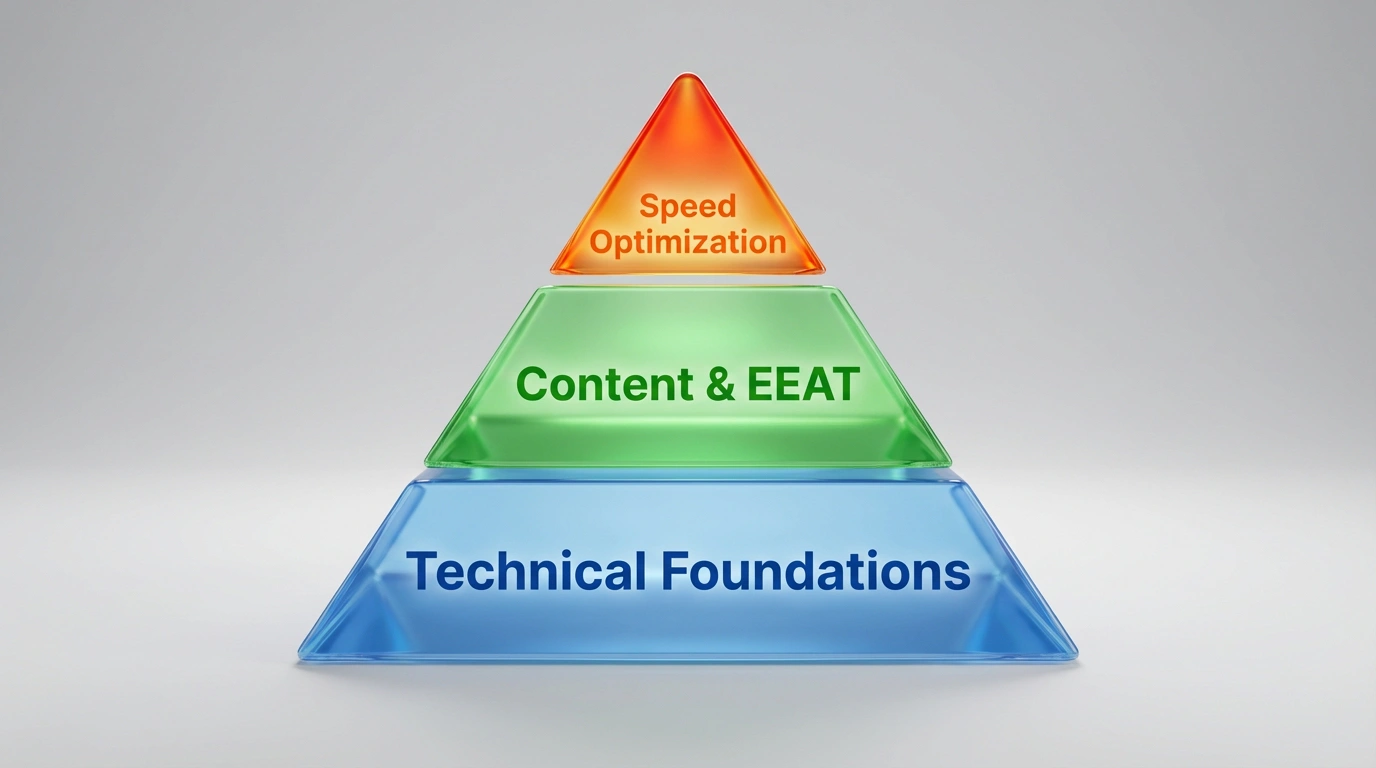
Technical audits performed by Ulement frequently reveal that agencies mislead clients by insisting on a “100/100” score. This demand often serves as a sales tactic for unnecessary billable hours. Internal data proves that numerous high-traffic websites with mobile scores as low as 50/100 consistently rank at the top of search engine results pages. Google prioritises Technical Foundations, EEAT signals, and Content Quality over synthetic lab scores.
Why Is a Perfect 100 PageSpeed Score Unnecessary?
Core Definition: The Reality
The 2010 Speed Update and subsequent Core Web Vitals rollouts were targeted algorithm changes designed to penalise only the slowest 1% of websites. These updates do not reward the fastest 1% with disproportionate ranking boosts.
Architect’s View
Digital agencies and SEO professionals frequently advise clients based on generic SEO tool reports and industry news rather than operational experience. These theoretical markers lead to a misinterpretation of updates as mandates for lightning-fast speeds. Google documentation consistently states that relevance remains the primary ranking factor: a fast page with low-quality content will never outrank a slower page with high-value answers.
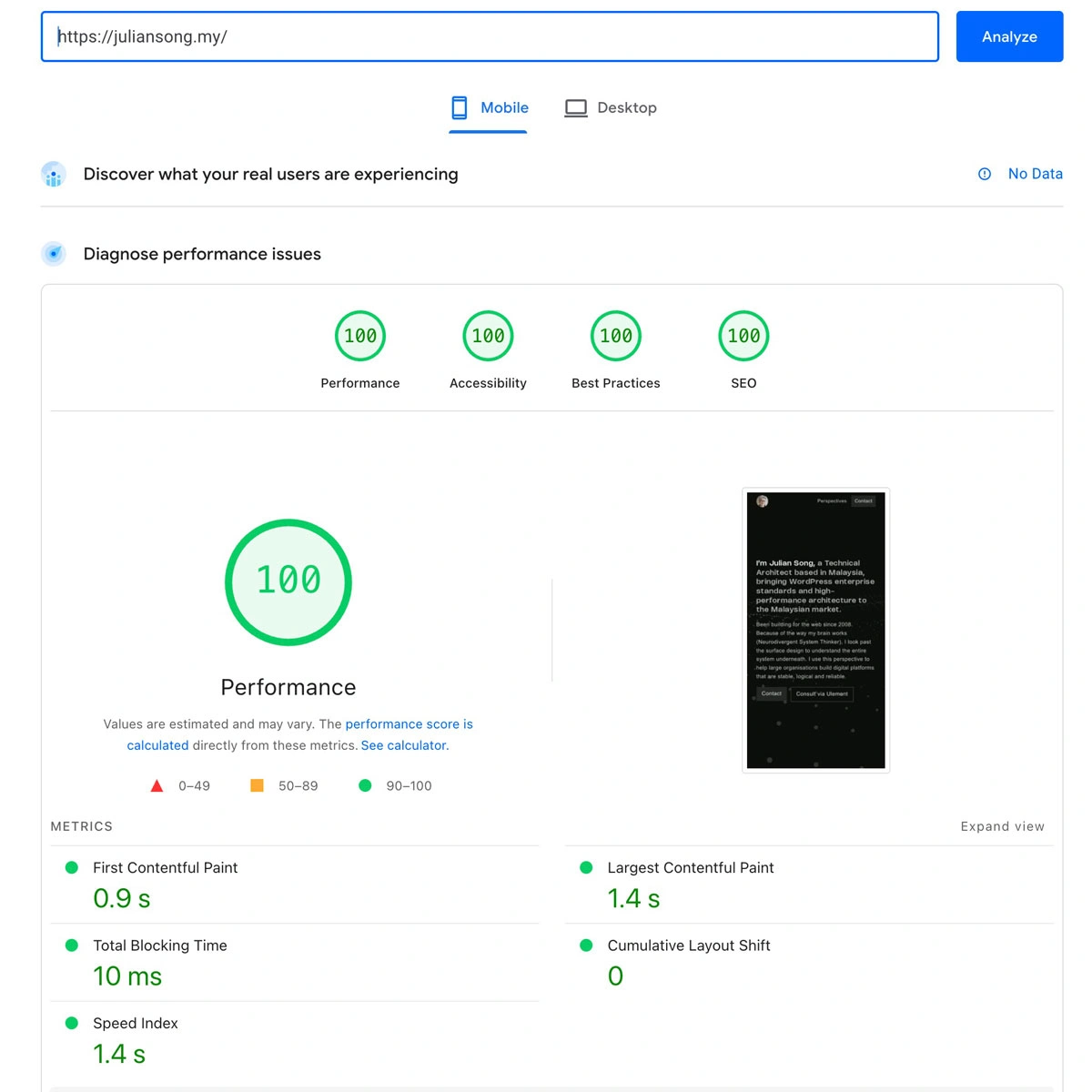
Julian Song advise clients to view speed as a binary pass/fail metric. Once a site passes the “Good” threshold for Core Web Vitals, further speed improvements yield diminishing returns compared to investing in better content.
|
Factor |
Impact |
Ulement Recommendation |
|---|---|---|
|
Speed vs Content |
Content Win |
Relevance outweighs raw speed. |
|
Primary Signal |
No |
Speed is a tie-breaker for identical pages. |
|
Score Target |
70-90 |
Focus on “Passing” Core Web Vitals. |
How Does Lab Data Differ From Field Data?
Core Definition: The Metric
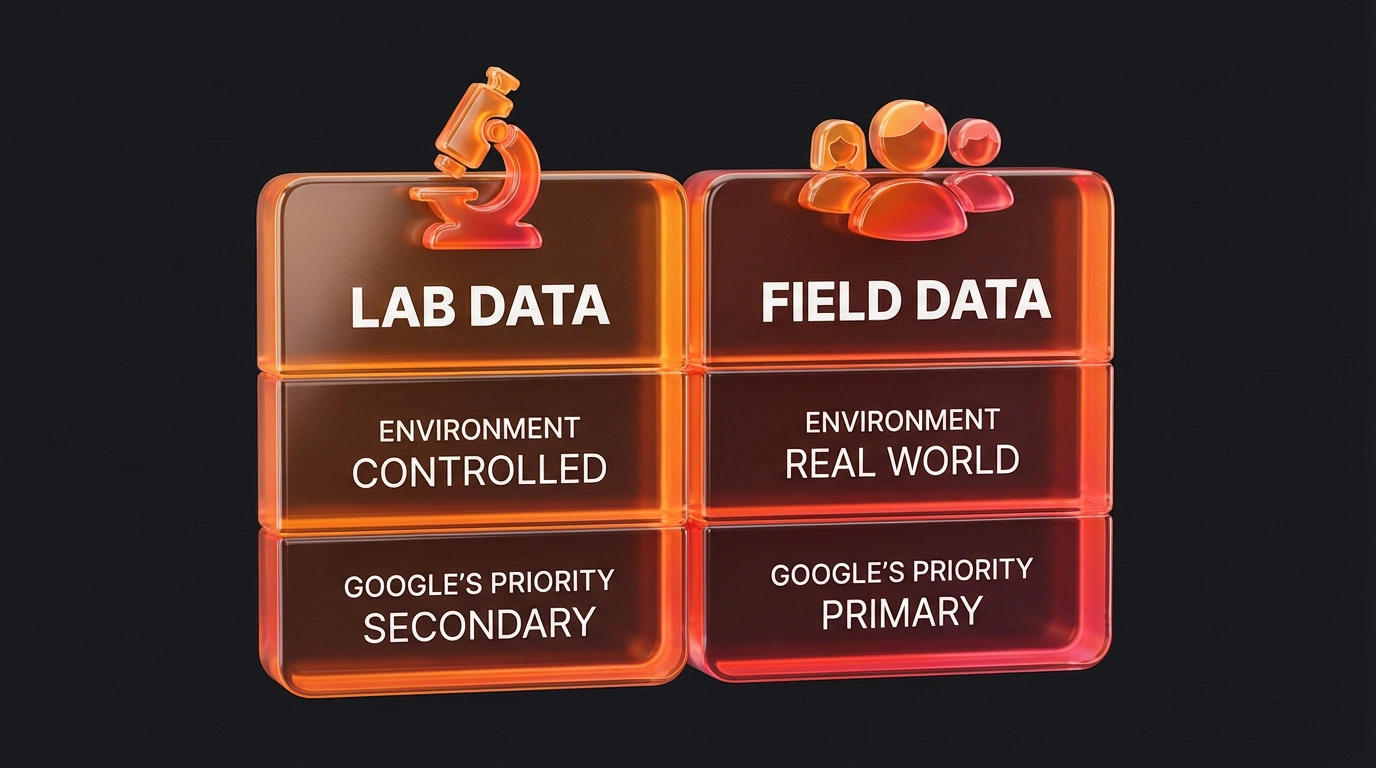
Lab Data (Lighthouse) represents a synthetic test environment that estimates performance under fixed conditions. Field Data (CrUX) measures what real users actually experience.
Architect’s View
Lab Data functions like a wind tunnel test for a vehicle: it measures aerodynamic theory. Field Data represents the actual race, involving traffic, weather, and driver skill.
Google rankings rely on the race results found in Field Data. Sites with a “60” Lab Score often pass Core Web Vitals because real-world users possess fast devices and stable connections. Prioritising Lab Scores while ignoring Field Data constitutes a strategic error.
What Technical SEO Foundations Actually Matter for Rankings?
Core Definition: The Hierarchy
Crawlability is the technical capability that allows search engine bots to discover and access content. This factor sits at the absolute foundation of the SEO hierarchy.
Architect’s View
Search engines must find and understand pages before speed becomes relevant. A lightning-fast site provides no value if the robots.txt file blocks crawlers or the internal linking structure creates orphan pages.
Ulement prioritises Mobile-First Indexing compatibility over raw speed. A site that loads in 0.5 seconds but renders poorly on mobile will suffer a ranking penalty far more severe than a site that loads in 2.5 seconds with a perfect mobile experience. Security (HTTPS), Mobile Responsiveness, and Crawlability are binary requirements.

Technical SEO Architect: The Foundation for Enterprise Growth

WordPress Security vs. Speed: How to Secure High-Traffic Sites

How to Improve WordPress Core Web Vitals
How Does EEAT Influence Rankings Compared to Page Speed?
Core Definition: The Trust Factor
EEAT is a quality framework that evaluates Experience, Expertise, Authoritativeness, and Trustworthiness. This framework acts as the primary filter for “Your Money or Your Life” (YMYL) topics.
Architect’s View
Google algorithms prefer a trusted expert on a standard server over an anonymous author on a high-performance server. Trust serves as the primary currency of the web.
Topical Authority built through comprehensive content clusters yields significantly higher ROI than shaving 0.2 seconds off load time. Budgets should support demonstrating expertise rather than just code refinement. EEAT signals are vital: a slow site with high trust will outrank a fast site with low trust.
Which User Engagement Signals Outweigh Speed?
Dwell Time and Click-Through Rate (CTR) are indirect ranking signals that indicate user satisfaction. If users stay on a page to read a 2,000-word guide, Google interprets this as a sign of value. If they load a page instantly but leave because the content is thin, rankings will drop.
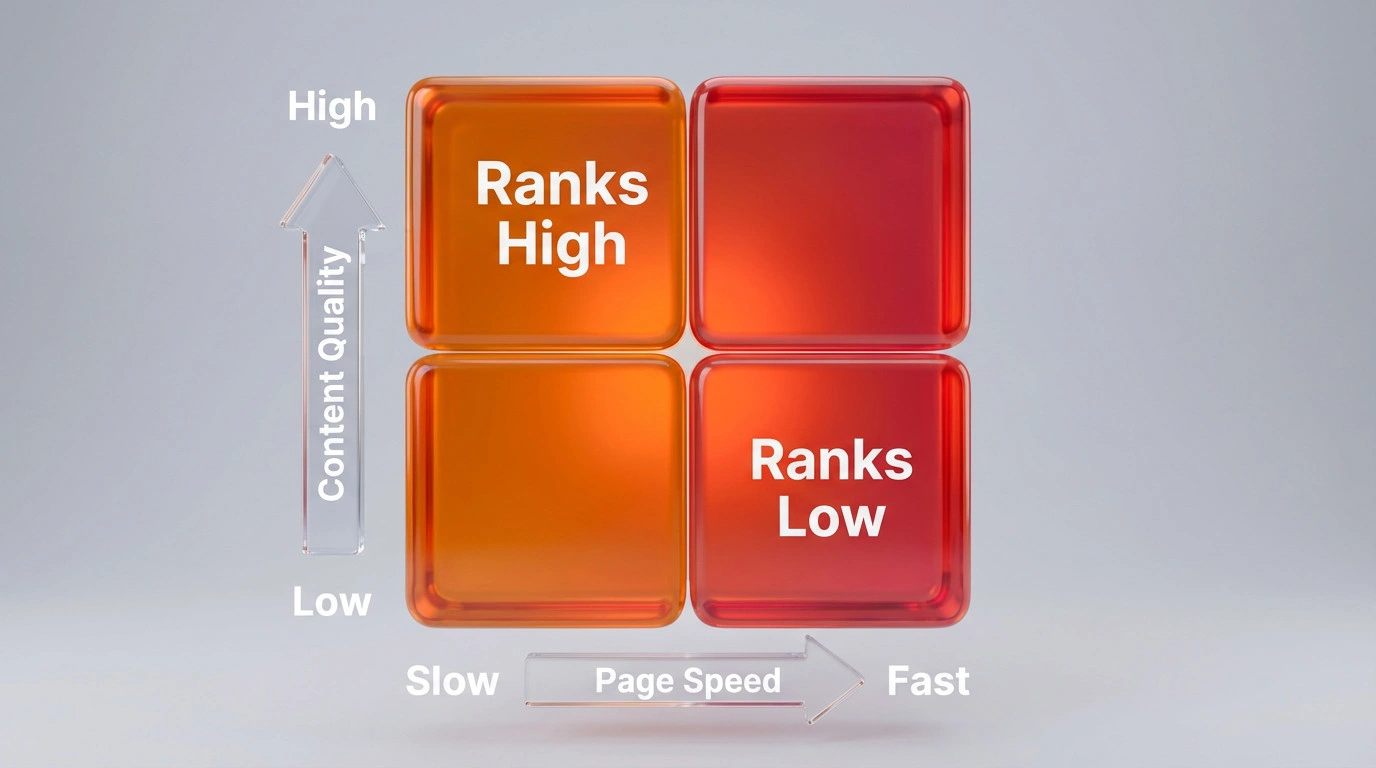
User Experience (UX) encompasses usability, accessibility, and layout stability. Broken navigation or a confusing layout hurts SEO more than a 2-second load time. Users tolerate a brief wait for a great experience: they do not tolerate a fast but broken interface. Intuitive navigation and scannable content keep users engaged, often compensating for moderate load speeds.
What Is the Law of Diminishing Returns in Speed?
Diminishing Returns is an economic principle where incremental investment yields progressively smaller results. Optimising images and using server-side caching delivers 80% of the speed benefit.
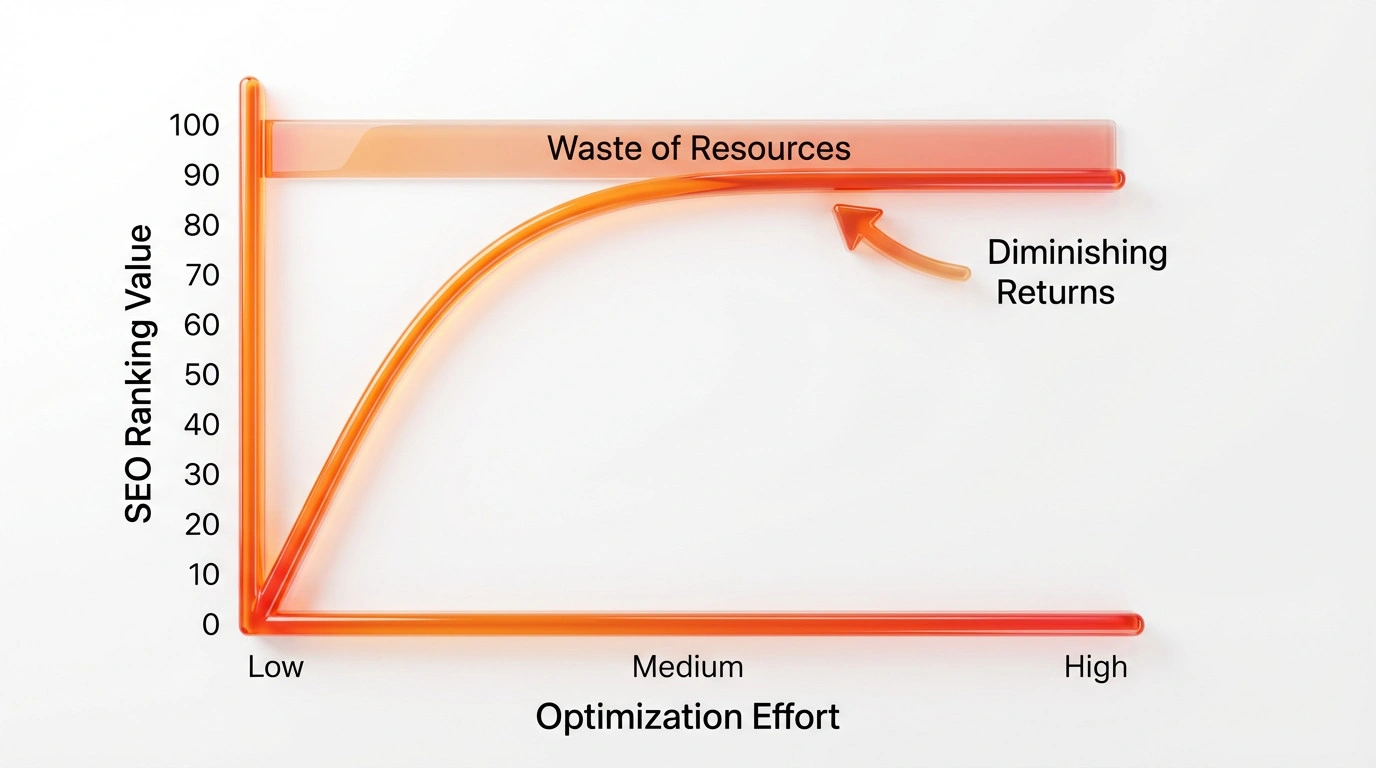
Ulement data indicates that for most websites, achieving a “Green” Core Web Vitals score requires a comprehensive website revamp. Technical efforts required to force a site from a score of 90 to 100 are massive. This process often involves rewriting entire codebases for negligible SEO gain. Ulement recommends prioritising Content Strategy and User Experience over technical perfection. Resources generate better ROI when allocated to content rather than a structural rebuild for a perfect score.
How Should You Prioritise SEO Efforts?
The Ulement Framework recommends this prioritisation model for Enterprise clients:
- Technical Foundations: Ensure crawlability, indexation, and security.
- Content and EEAT: Build relevance, trust, and entity authority.
- User Experience: Optimise layout, navigation, and accessibility.
- Performance: Achieve “passing” Core Web Vitals (Green).
- Micro-Optimisation: Chase perfect scores only with surplus budget.
Content depth and backlink acquisition remain the best strategies for maximum impact. A balanced strategy outperforms a technically perfect but content-poor website.
Stop Chasing the Green Circle. Would you like Julian Song to audit your current content strategy to ensure your “fast enough” site is actually “good enough” for Google? Let us shift focus from milliseconds to market authority.