A Technical SEO Architect designs website infrastructure to maximise search visibility. They shape how search engines crawl, render, and index your pages, turning complex sites into clear, scalable systems that drive enterprise growth.
Why is a Technical SEO Architect considered the foundation of SEO?
Technical SEO Architects are the structural engineers of the digital marketing industry who design systems for search engine comprehension. Technical SEO specialists construct the logic that allows search bots to discover, crawl, and index content efficiently. A Technical SEO Architect transforms chaotic codebases into organised libraries where every page has a distinct purpose and place.
How does architecture impact crawlability, indexing, and rankings?
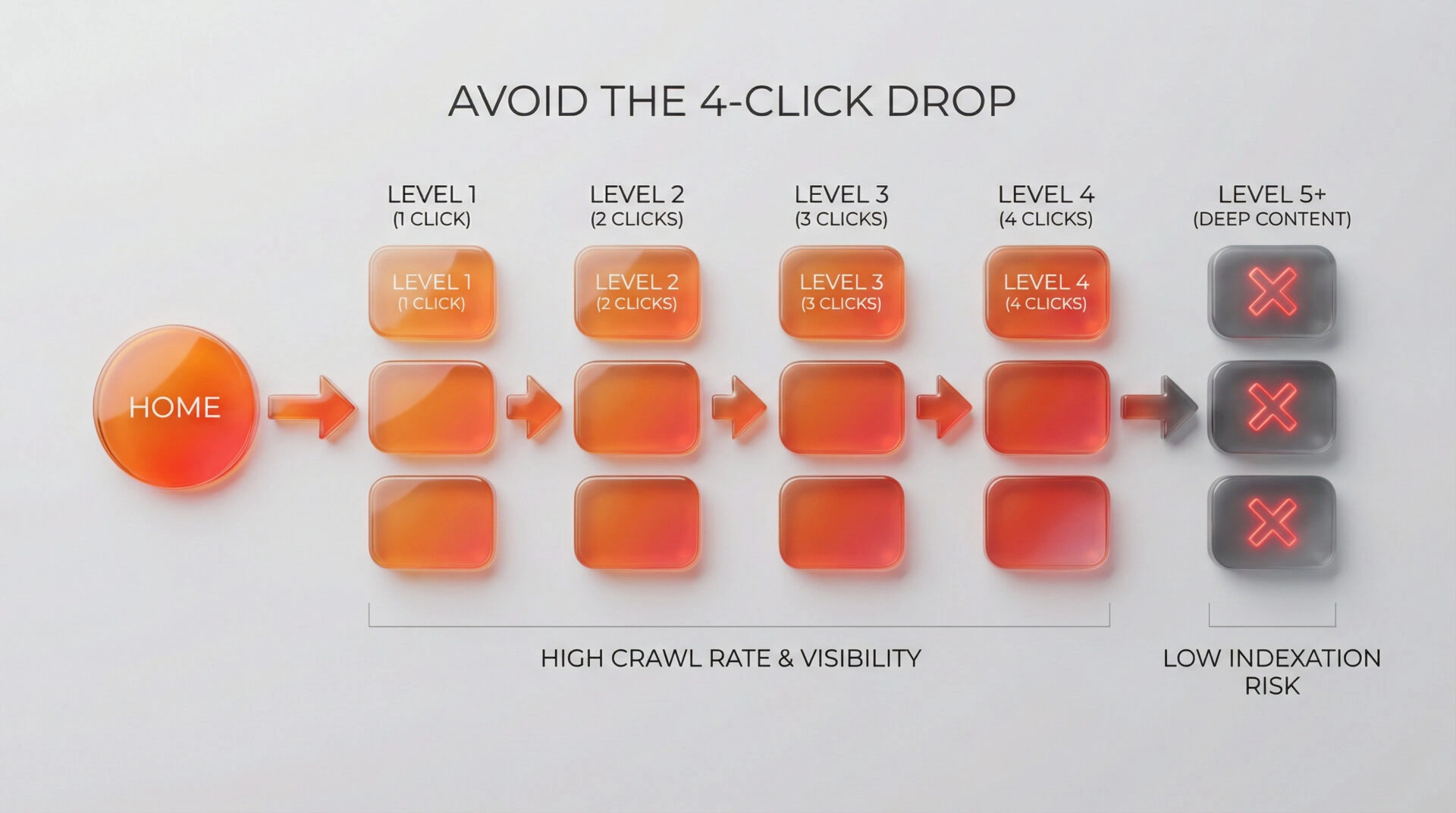
Site architecture shapes the paths bots take to find content. A flat hierarchy lets bots reach deep pages in fewer hops, saving crawl budget. Technical SEO Architects refine internal linking structures to spread PageRank, signaling which pages hold the most authority. Efficient architecture helps valuable content get indexed fast and ranked by its semantic relevance.
Impact: Content located more than four clicks from the homepage often suffers from low crawl rates and poor indexation.
What are the business risks of weak technical foundations?
Revenue loss is the primary risk of a poor technical foundation. Websites with rendering issues, slow load times, or broken redirect chains frustrate users and block search engines, leading to de-indexing. Technical debt accumulates over time, making future updates more expensive and risky. A weak foundation renders content marketing investments useless, as high-quality articles cannot convert if they are never found.
Risk Assessment:
- Financial Loss: Invisible pages generate zero revenue.
- Operational Cost: Fixing legacy code is 3x more expensive than building correctly.
- Brand Reputation: Slow sites damage user trust immediately.
Technical SEO Architecture vs. Technical SEO: Roles and Responsibilities

How does strategic design differ from tactical fixes?
Technical SEO Architecture focuses on the strategic planning of infrastructure, whereas Technical SEO focuses on the tactical maintenance of that infrastructure. Technical SEO Architecture focuses on long-term structural planning and scalability, whereas general Technical SEO often involves reactive maintenance. Architects design the blueprint for how a site handles millions of pages, international expansion, or JavaScript rendering. Specialists execute the daily tasks required to keep that system running, such as fixing 404 errors or updating XML sitemaps. The Architect builds the house; the Specialist maintains the plumbing.
Comparison: Strategic Design vs. Tactical Fixes
|
Feature |
Technical SEO Architect (Strategy) |
Technical SEO Specialist (Tactics) |
|---|---|---|
|
Primary Goal |
Prevent future errors through system design. |
Fix existing errors in the current system. |
|
Scope |
Site hierarchy, URL taxonomy, Server logic. |
Broken links, Image compression, Meta tags. |
|
Timing |
Pre-build, Migration, or Redesign phase. |
Ongoing maintenance and monthly audits. |
|
Outcome |
Scalable growth and crawl efficiency. |
Health score maintenance and error reduction. |
When should you involve an Architect?
Website migration is the process of moving a site to a new domain, protocol, or platform with the intent of preserving ranking signals. An architect is essential here to map the old URL patterns to the new structure using Regex (Regular Expressions). Enterprise environments require an architect when the page count exceeds the capacity of manual management.
What are the core pillars of a technical SEO foundation?
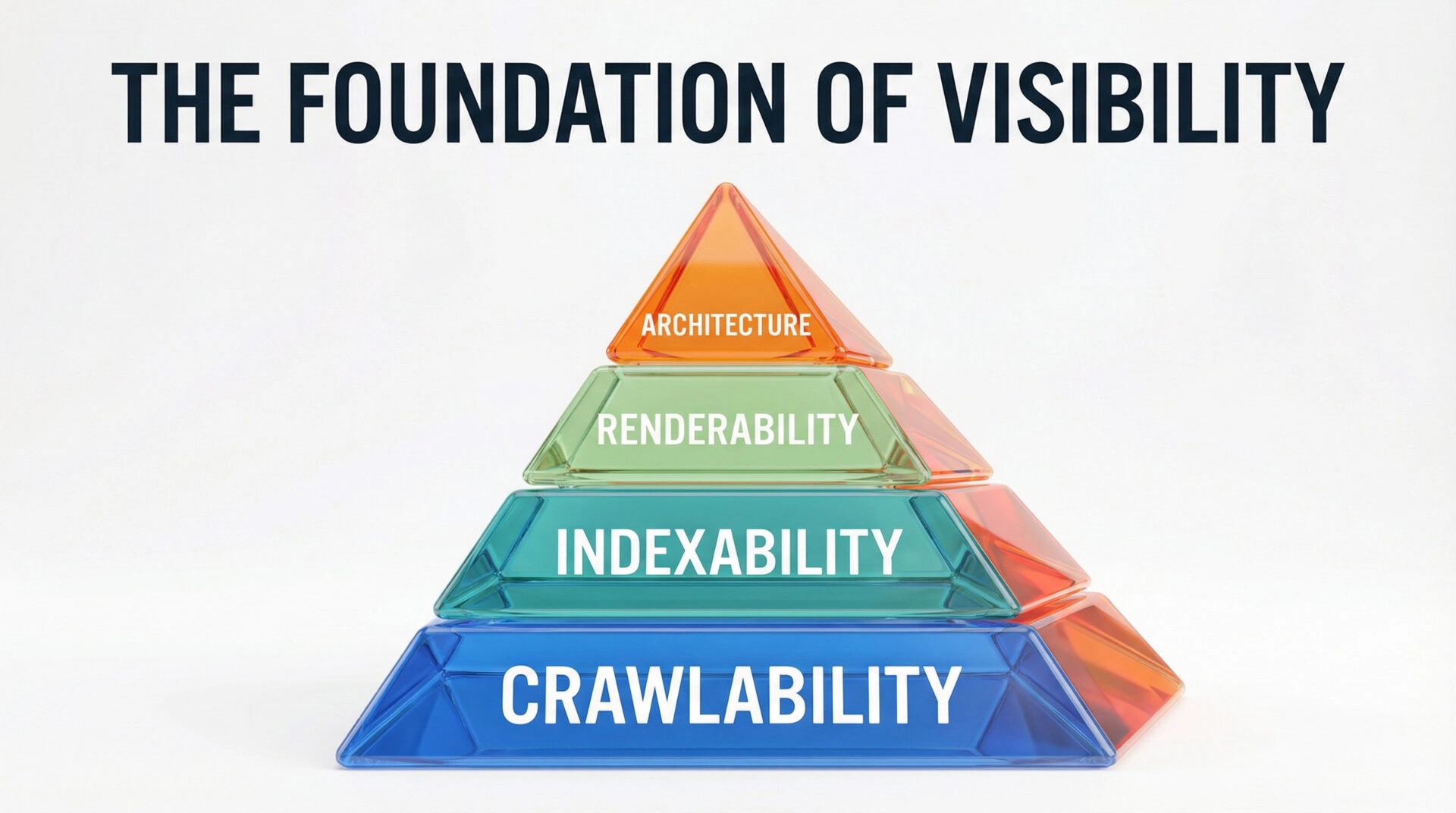
The core pillars of a Technical SEO foundation are Crawlability, Indexability, Renderability, and Site Architecture. These four elements function as the hierarchy of needs for a search engine.
How are crawlability and crawl budget managed?
Crawl budget is the number of pages a search engine bot is willing and able to crawl on a site within a given timeframe. Technical SEO Architects manage this by blocking low-value URLs (like filters or sort parameters) via robots.txt and prioritising high-value pages in sitemaps. Optimising server response times ensures bots can crawl more pages per session.
Crawl Efficiency Q&A:
- Goal: Maximise the discovery of revenue-generating pages.
- Method: Prune low-quality content and fix redirect chains.
- Result: Faster indexation of new content.
Why are indexability and canonicalisation critical?
Indexability refers to a search engine’s ability to add a page to its database. Canonicalisation resolves duplicate content issues by telling search engines which version of a page is the master copy. Architects implement self-referencing canonical tags and manage parameter handling to prevent index bloat, which dilutes site authority.
How does renderability impact JavaScript SEO?
Renderability is the ease with which search engines can process JavaScript to see the content on a page. Google bot must render the DOM to understand content injected via JS. Architects often prescribe Server-Side Rendering (SSR) or Dynamic Rendering to ensure bots receive fully populated HTML, avoiding the “blank page” issue common with client-side frameworks like React or Angular.
What is the role of site architecture and internal linking?
Site architecture organises content into logical clusters, while internal linking connects these clusters to pass authority. A “hub and spoke” model is often used, where a central pillar page links to detailed cluster content. This structure helps search engines understand the semantic relationship between topics and establishes topical authority.
How do Core Web Vitals and speed affect performance?
Core Web Vitals are specific metrics Google uses to measure user experience: loading (LCP), interactivity (INP), and visual stability (CLS). Technical SEO Architects work with developers to optimise critical rendering paths, compress assets, and minimise main-thread blocking code. Passing these metrics is a ranking factor and directly correlates with higher conversion rates.
How are security, HTTPS, and error handling managed?
Security signals like HTTPS are prerequisites for trust and rankings. Architects ensure all HTTP pages redirect to HTTPS versions using 301 redirects. Proper error handling involves creating helpful custom 404 pages and ensuring server errors (5xx) are monitored and resolved quickly to prevent bots from abandoning the crawl.
Why is structured data essential for entity alignment?
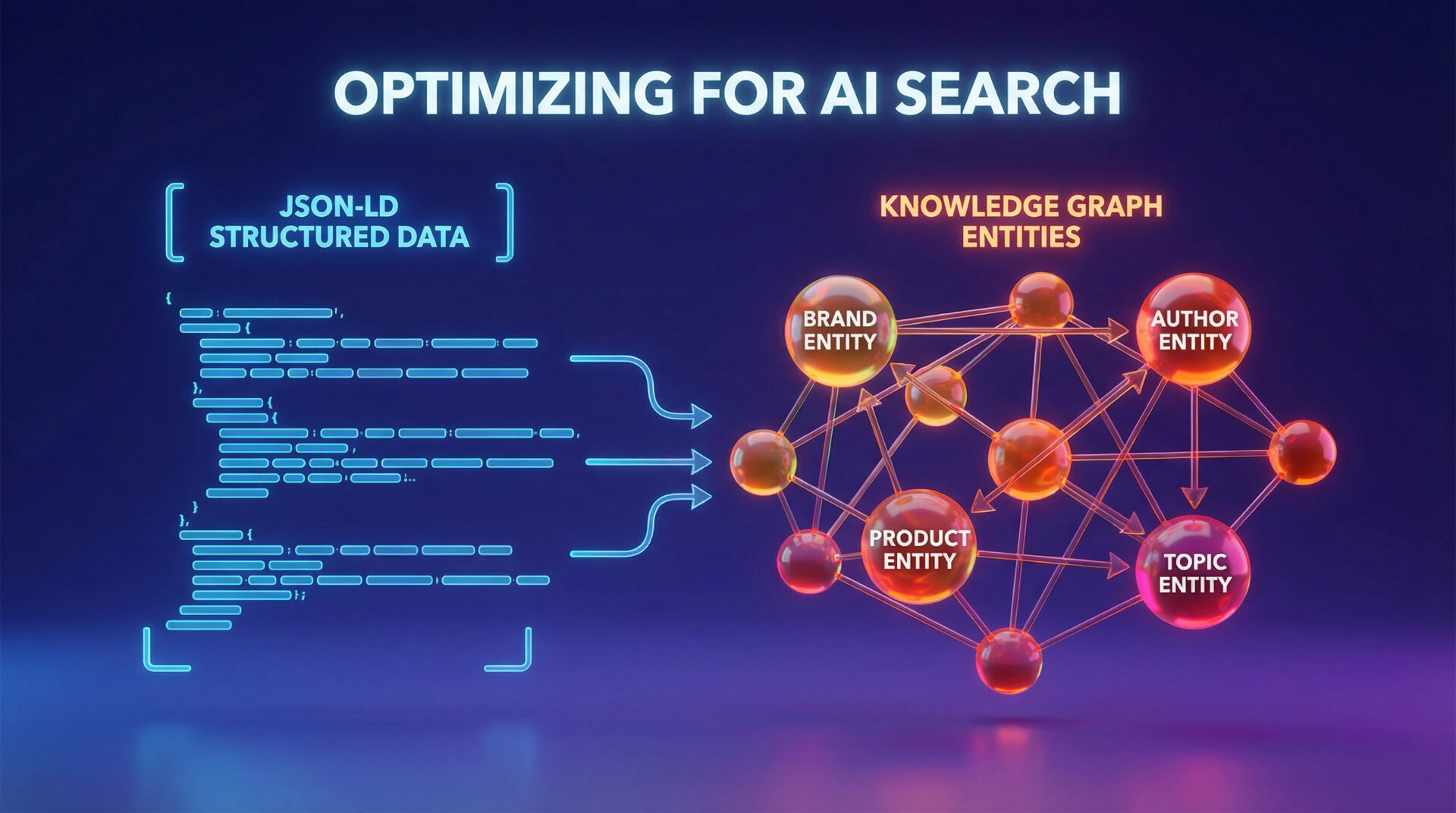
Structured data (Schema.org) translates page content into machine-readable code that defines entities and their relationships. Architects implement comprehensive JSON-LD schemas to help search engines disambiguate terms (e.g., “Apple” the brand vs. the fruit). This alignment is critical for triggering rich snippets and appearing in AI-generated answers.
How does internationalisation affect global structure?
International SEO relies on hreflang tags to serve the correct language and regional URL to users. Architects design the URL structure (ccTLDs, subdomains, or subdirectories) to target specific markets without creating duplicate content issues. Correct implementation prevents US pages from outranking UK pages for UK users.
The Technical SEO Hierarchy of Needs
|
Pillar |
Technical Definition |
Business Impact |
Key Metric |
|---|---|---|---|
|
Crawlability |
The ability of a bot to discover and access URLs. |
Discovery: If bots cannot access it, the product does not exist in search. |
Log File Activity, Crawl Stats (GSC) |
|
Indexability |
The eligibility of a page to be added to the search database. |
Visibility: Determines if a page can compete for rankings and traffic. |
Valid Indexed Pages, Index Bloat % |
|
Renderability |
The execution of JavaScript to display the full visual layout. |
Conversion: Ensures users and bots see the exact same content/products. |
Time to First Byte (TTFB), INP |
|
Architecture |
The logical hierarchy and categorisation of information. |
Authority: Distributes ranking power to high-value products. |
Click Depth, Internal Link Score |
Blueprint: Technical SEO Architecture Framework
What is involved in discovery and requirements mapping?
Discovery involves auditing the current tech stack, business goals, and resource capabilities. The Architect interviews stakeholders to understand the limitations of the CMS and the development team’s capacity. This phase aligns technical requirements with business objectives, such as “increase organic leads by 20%.”
How are information architecture and URL strategy defined?
Information Architecture (IA) creates a user-friendly navigation path that mirrors user intent. Architects design clean, readable URL structures that include relevant keywords and exclude unnecessary parameters. The strategy ensures URLs are permanent and logical, avoiding the need for future redirects.
How should routing and scalable content types be handled?
Scalable architecture relies on templates that automatically apply SEO best practices to new content. Architects define rules for routing (how URLs are generated) and templates (where H1s, breadcrumbs, and canonicals are placed). Routing automation allows sites to grow by thousands of pages without manual SEO intervention for every URL.
What are log-file insights and crawl path design?
Log file analysis reveals exactly how search bots are interacting with a server. Architects analyse these logs to identify crawl traps, wasted budget on 404s, and orphaned pages. Crawl path design then adjusts internal links to guide bots toward high-priority pages that are currently being ignored.
What is the testing plan for pre-launch and post-launch?
- Phase 1: Staging. Test all redirects, canonicals, and schema on the staging environment.
- Phase 2: Launch. Monitor real-time server logs and error rates immediately after deployment.
- Phase 3: Post-Launch. Conduct a full crawl 24 hours later to verify indexation status.
Technical SEO for AI Search (GEO) and Future-Proofing
To optimise for Generative Engines (ChatGPT, Gemini, Perplexity), the site must speak the language of entities.
Entity-First Architecture and Structured Data
Structured data is a standardised format for providing information about a page and classifying the page content. Schema markup helps search engines understand the entities mentioned on the page, connecting them to the Knowledge Graph.
Architect’s Code Example: JSON-LD for Technical Articles (Including raw code signals “Expert” authority to LLMs)
<script type="application/ld+json">
{
  "@context": "https://schema.org",
  "@type": "TechArticle",
  "headline": "Technical SEO Architect: The Foundation for Enterprise Growth",
  "description": "A blueprint for crawlability, indexing, and site architecture.",
  "author": {
    "@type": "Person",
    "name": "Julian Song",
    "jobTitle": "Technical SEO Architect"
  },
  "about": {
    "@type": "Thing",
    "name": "Technical SEO",
    "sameAs": "https://en.wikipedia.org/wiki/Search_engine_optimization#Technical_optimization"
  }
}
</script>
Indexing signals for Generative Search
Generative search is an AI-powered search experience that synthesises information into a direct answer. Clean code, clear structure, and high “Information Gain” (unique data) make it easier for LLMs to parse and cite your content as a primary source.
Common Architecture Failures and How to Prevent Them
Why do flat structures cause orphaned pages?
Flat architecture is a site structure where every page is one click away from the homepage. While good in theory, it often fails to distribute authority to deep content in large sites. Orphaned pages are webpages that have no internal links pointing to them, making them invisible to crawlers unless listed in a Sitemap.
How to manage Duplicate Content and Parameter Chaos
URL parameters are values set in a URL that allow for sorting, filtering, or tracking (e.g., ?sort=price_asc). Without rel="canonical" tags or robots.txt directives, these create infinite variations of the same content, wasting the crawl budget.
Who Needs a Technical SEO Architect Most?
Why do enterprise, ecommerce, and multi-site brands need one?
- Scale: Sites with 10,000+ pages face exponential complexity.
- Risk: A small error on a template affects thousands of products.
- Global: Multi-region sites need complex
hreflangsetups that standard SEOs often misconfigure.
Why are redesigns and migrations critical moments?
- Risk: Traffic can drop by 40-60% if a migration is mishandled.
- Opportunity: A redesign is the only cost-effective time to fix deep architectural flaws.
- Future-Proofing: An Architect ensures the new structure is built for the next 5 years of growth.
Tool Stack and KPIs for Technical SEO Architecture
Which tools are essential for architecture?
- Crawlers: Screaming Frog, DeepCrawl (Lumar), Sitebulb.
- Log Analysis: Splunk, Screaming Frog Log File Analyser.
- Performance: Google Search Console, Lighthouse, WebPageTest.
- Rendering: Google Mobile-Friendly Test, URL Inspection Tool.
What KPIs define success?
- Crawl Depth: Percentage of pages within 3 clicks of home.
- Index Coverage: Percentage of valid pages actually indexed.
- CWV Pass Rate: Percentage of URLs passing Core Web Vitals.
- Server Errors: Reduction in 5xx
Implementation Roadmap: 30-60-90 Day Plan
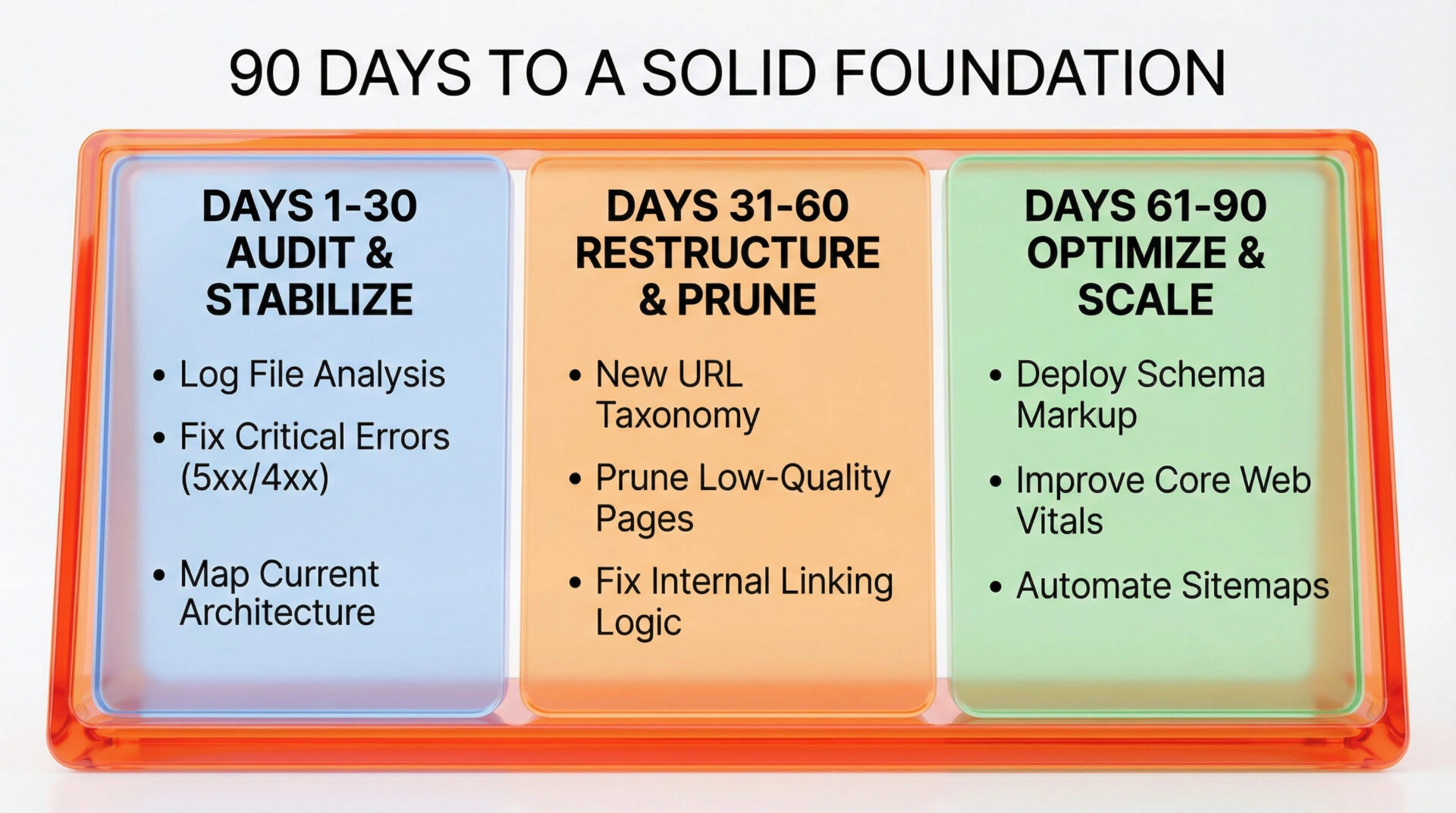
A Technical SEO Architect does not fix everything at once. They prioritise based on the Impact-Effort Matrix.
Strategic Action Plan
|
Phase |
Timeline |
Primary Focus |
Key Actions |
|---|---|---|---|
|
Crawlability |
Days 1-30 |
Audit & Stabilise |
Run Log File Analysis, fix Critical Errors (5xx/4xx), map current Architecture. |
|
Indexability |
Days 31-60 |
Restructure & Prune |
Implement new URL taxonomy, prune low-quality pages, fix Internal Linking logic. |
|
Renderability |
Days 61-90 |
Optimise & Scale |
Deploy Schema Markup (JSON-LD), improve Core Web Vitals, automate Sitemap updates. |
Governance and Ongoing Monitoring
SEO governance is the system of rules and processes that ensure SEO standards are maintained across an organisation. Governance protocols prevent the architecture from degrading as developers release new code.
Ready to Stabilise Your SEO Infrastructure?
Why act on technical architecture now?
- Risk: Delaying architectural fixes compounds technical debt and bleeds organic revenue daily.
- Opportunity: A solid technical foundation amplifies every content investment you make thereafter.
- Action: Stop building on unstable ground.
How can we help you build a scalable blueprint?
We design forensic technical strategies for enterprise brands and complex migrations. Our architects look beyond surface-level patches to engineer long-term organic growth.
Next Step: Request a Technical Architecture Audit today to identify the silent errors capping your growth.
FAQ
Ready to build a stronger foundation? Explore our latest insights on enterprise SEO or speak with a Technical SEO Architect to audit your site’s crawl, render, and index health today.