The transition from traditional search to Search Generative Experience (SGE) has moved from theoretical roadmap to operational reality. Enterprise technical SEO is no longer a marketing line item. It is a financial risk variable that boards must address before legacy infrastructure erodes regional market share. Google’s AI Overviews now appear on more than 47% of commercial queries globally, and Gemini, ChatGPT, and Perplexity collectively process over 2 billion search-equivalent prompts each month. The corporations bleeding revenue in this transition share one trait: technical debt that LLMs cannot parse.
Key Takeaways
- SGE has converted enterprise technical SEO from a marketing expense into a board-level financial risk.
- Organic traffic for ASEAN enterprises is declining 18% to 34% annually due to zero-click AI Overview attrition.
- Three failures dominate: TTFB above 800ms, fragmented schema, and JavaScript-hidden content.
- Schema markup will shift from best practice to regulatory obligation in finance and healthcare by 2027.
- Delaying remediation typically inflates customer acquisition cost by 30% to 60% within 18 months.
The Shift: From SERPs to Synthetic Answers
Search engines have stopped behaving like directories. They behave like answer engines. Google’s SGE, Microsoft’s Copilot integration, and standalone LLMs synthesise responses directly from indexed content, often without delivering a click. The blue-link economy is contracting.
This is not a marketing trend. It is an architectural inversion. The websites that earn citation in AI-generated overviews are not the ones with the largest backlink profiles. They are the ones engineered for machine parsing: clean semantic markup, structured data graphs, and zero-latency delivery. We covered the foundational shift in our analysis of how to be optimised for LLMs.
Who Is Affected and When
Every enterprise with a corporate website is affected. The timeline is now. Banks, telcos, healthcare networks, GLCs, and PLCs across ASEAN are seeing organic traffic decline by 18% to 34% year-on-year, even when keyword rankings remain stable. The cause is zero-click attrition: users receive answers from AI Overviews and never visit the source.
Sectors with the highest exposure include:
- Financial Services: regulated content is heavily summarised by AI engines
- Healthcare: YMYL content faces aggressive E-E-A-T filtering
- B2B SaaS and Enterprise Tech: commercial queries increasingly resolved by Perplexity and Gemini
- Ecommerce: product discovery shifting to conversational interfaces
Why Legacy Architectures Are Failing Enterprise Technical SEO
The dominant failure mode is not poor content. It is unparseable infrastructure. Most corporate WordPress installations were built between 2018 and 2022 by agencies focused on visual design. They use bloated page builders, render-blocking JavaScript, and inconsistent schema. LLMs cannot extract structured meaning from these sites efficiently.
We documented this disconnect in our piece on why beautiful websites are broken for search engines. Visual polish does not equal machine readability. The same applies to semantic HTML, which most agencies still treat as optional.
The Three Architectural Failures
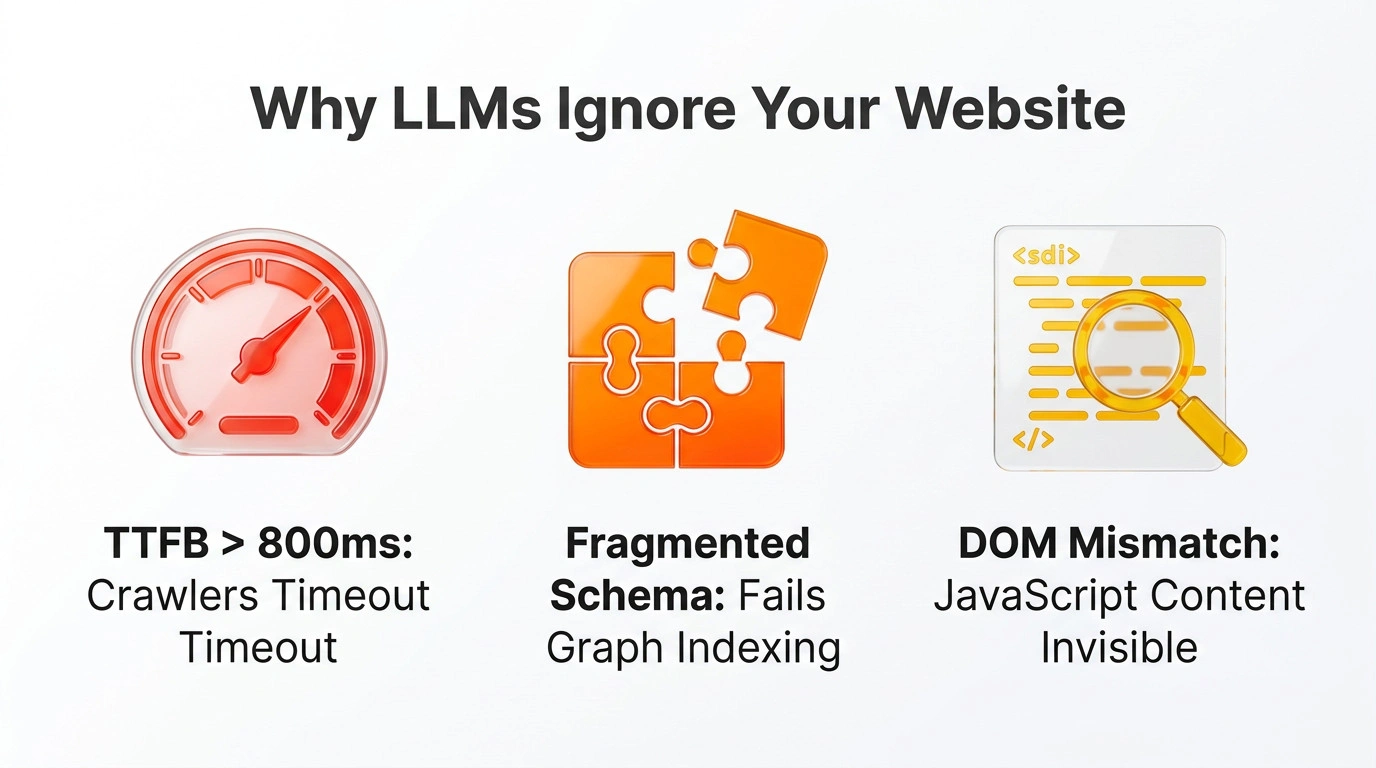
- Latency above 800ms TTFB: LLM crawlers timeout aggressively and skip slow endpoints
- Schema fragmentation: isolated JSON-LD blocks without entity relationships fail graph indexing
- Content-DOM mismatch: JavaScript-rendered content invisible to non-headless crawlers
The Infrastructure Assurance Mandate
Infrastructure assurance is the practice of engineering digital assets to guarantee uptime, parseability, and algorithmic compliance under adversarial conditions. It is the operational discipline that protects enterprise revenue from algorithmic volatility.
The core components are server configuration, schema architecture, security hardening, and content structure. Each must function as a unified system. A site with perfect schema but 3-second load times fails. A site with sub-200ms TTFB but no entity graph fails. Both must be solved simultaneously.
This is where the gap between commodity agencies and technical SEO architects becomes commercially significant. We explained the operational distinction in why a technical SEO architect is the foundation of enterprise growth.
Expert Perspective: The Citation Economy
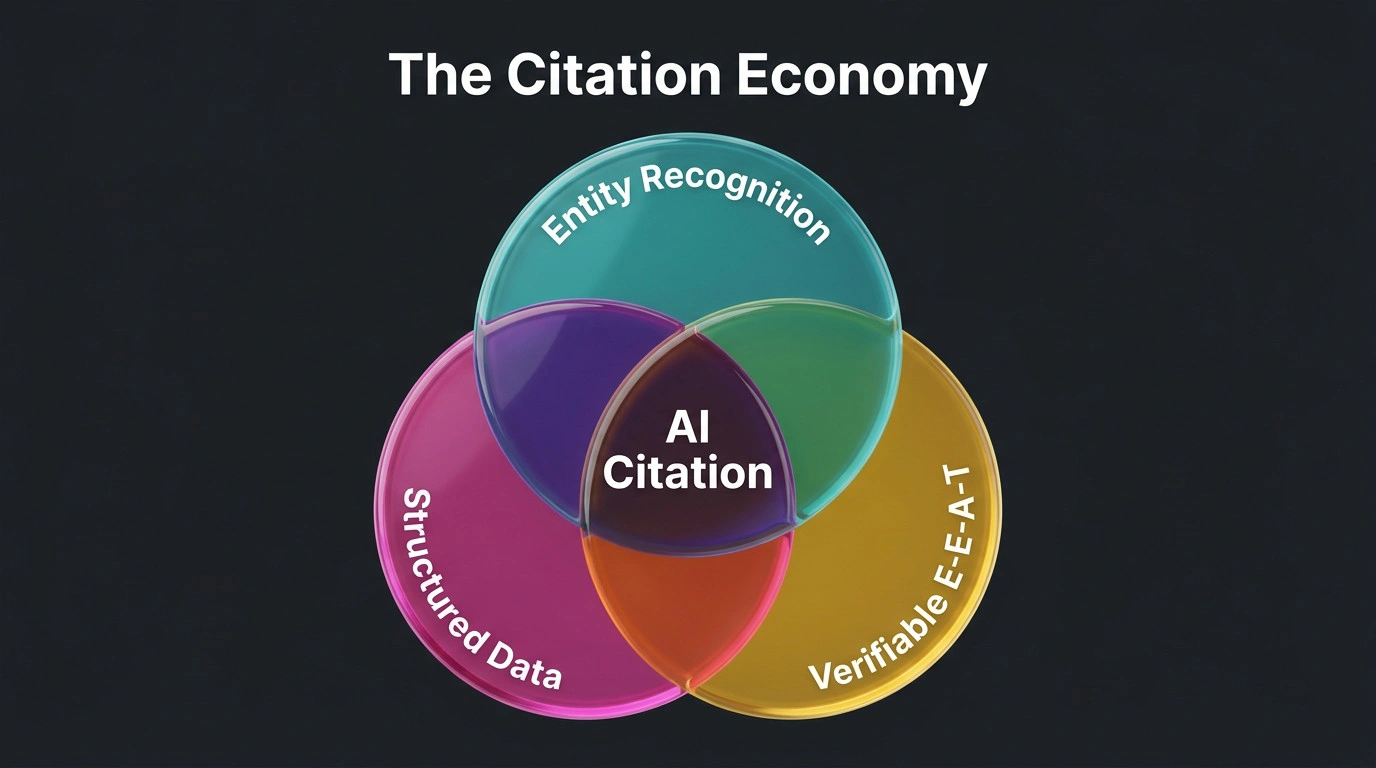
Industry analysts at Gartner predict that by 2028, organic search volume will drop by 25% as users shift to AI assistants. The corporations that survive will be those cited inside AI responses, not those ranking on page one. Citation requires three conditions: authoritative entity recognition, structured data integrity, and verifiable E-E-A-T signals. Read our enterprise framework on E-E-A-T signals for the full protocol.
ASEAN Market Share Implications
Regional dynamics intensify the risk. ASEAN enterprises face a dual exposure: global LLM models trained primarily on English-language Western data, and local competitors who have already migrated to zero-latency architectures. Malaysian, Singaporean, and Indonesian PLCs that delay technical remediation will see foreign-domiciled competitors capture branded queries within their own markets.
The defensive response is multilingual technical architecture. Proper hreflang implementation, locale-specific schema, and regional CDN routing are non-negotiable. Without them, an enterprise’s Bahasa Malaysia or Mandarin content fails to surface in localised AI Overviews.
Future Predictions: 2026 and Beyond
Three structural shifts will define the next 24 months:
1. Schema Becomes Regulatory
Financial and healthcare regulators in Singapore and the EU are drafting requirements for machine-readable disclosure. Schema markup will move from SEO best practice to compliance obligation.
2. llms.txt Standardisation
The llms.txt protocol will mature into a de facto standard for AI crawl directives, similar to robots.txt in 2005. Enterprises without it will lose control over how LLMs ingest and represent their content.
3. Performance Thresholds Tighten
Google’s Core Web Vitals benchmarks will tighten. LCP under 1.8 seconds and INP under 150ms will become competitive baselines, not aspirational targets. Sites running on shared hosting or legacy page builders will be structurally unable to comply.
Executive Action Framework
For CEOs and Marketing Directors, the immediate priorities are diagnostic and structural.
- Commission a technical audit against SGE-readiness criteria, not legacy SEO checklists. Start with our technical SEO checklist.
- Quantify revenue exposure by mapping branded and commercial queries to current AI Overview presence using Google Search Console impression data.
- Audit infrastructure against zero-latency benchmarks. If TTFB exceeds 400ms, the hosting stack requires reengineering.
- Plan the migration using a controlled protocol. Our SEO migration checklist documents the zero-traffic-loss procedure.
- Establish governance for ongoing schema, security, and performance monitoring. This is not a one-time project.
The board-level reality is straightforward. Search infrastructure has become a tier-one operational asset. Treating it as a marketing expense produces predictable revenue erosion. Treating it as engineering produces algorithmic dominance. For a structural assessment, request a free strategic site audit.